
How to Adopt AI: A Roadmap for Australian Businesses
Successful AI adoption starts with a useful business problem, not a model demonstration. The first goal is to prove a bounded workflow can create measurable value without introducing unacceptable risk.
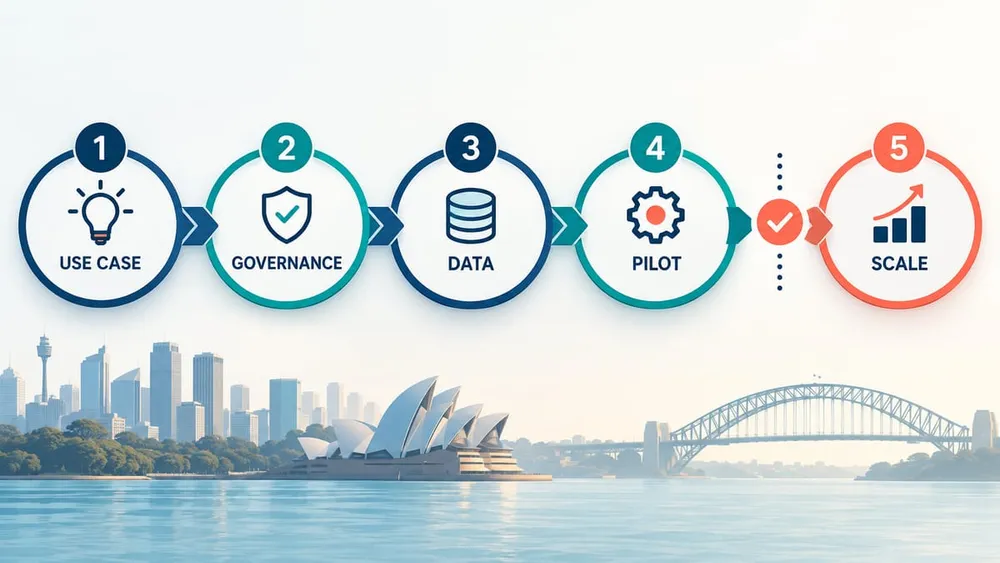
1. Choose a narrow use case
Write down the current process, volume, delay, error cost and owner. Good first candidates are repetitive, reviewable and supported by accessible information. Examples include classifying enquiries, drafting responses from approved material, extracting fields from standard documents or identifying content gaps.
Avoid beginning with autonomous high-stakes decisions, uncontrolled customer communication or broad access to production systems.
2. Establish the minimum governance
Name an accountable owner. Record the purpose, users, approved data, supplier, model or service, known limitations, human-review point, incident route and review date. The Australian Government's Guidance for AI Adoption recommends starting across all six responsible practices and adding maturity as use grows.
3. Prepare data and integration boundaries
Identify the authoritative systems and the minimum information the workflow needs. Separate read access from write access. Use test or staging environments and synthetic or de-identified data where practical. Confirm privacy, security, retention and contractual settings before real information is introduced.
4. Build a measurable pilot
Create a representative evaluation set before tuning the system. Compare the AI-assisted process with the current baseline. Track quality, unsupported claims, time saved, review effort, exceptions, user satisfaction, latency and cost. Include cases where the system should refuse or hand work to a person.
5. Scale in stages
- Read-only analysis and recommendations.
- Draft preparation with mandatory human review.
- Low-risk actions with validation and rollback.
- Broader automation only after evidence supports it.
Scaling means more than adding users. It requires ownership, monitoring, versioning, staff training, access reviews, incident handling and a plan for vendor or model changes.
A practical 90-day sequence
- Days 1–30: select the use case, map risk, prepare data and define success.
- Days 31–60: build the pilot, evaluate failures and document the operating process.
- Days 61–90: run with real reviewers, measure outcomes and decide whether to stop, revise or scale.
Continue with VaniTech's deeper guides: AI Agent Readiness Checklist, AI Integration Strategy and What to Buy, Build or Integrate.
How to Adopt AI: A Roadmap for Australian Businesses FAQs
Sources Checked
These primary sources were reviewed on 2026-09-17.
- Australian Government Department of Industry, Science and Resources: Guidance for AI Adoption: Foundations
- National Institute of Standards and Technology: AI Risk Management Framework
- OpenAI: A practical guide to building agents
- Office of the Australian Information Commissioner: Privacy considerations when selecting a commercially available AI product