
What Is AI? Artificial Intelligence in Plain English
Artificial intelligence is an umbrella term for computer systems designed to perform tasks that normally require human capabilities such as recognising patterns, interpreting language, making predictions or choosing an action. It is not one product and it is not a single level of intelligence.
AI is a capability, not a magic ingredient
Traditional software follows rules written in advance. An AI system often learns useful patterns from examples, then applies those patterns to new input. That distinction matters: a payroll formula should be deterministic, while identifying unusual transactions or classifying a customer message may benefit from a statistical model.
The Australian Cyber Security Centre describes modern AI as usually being built with machine-learning algorithms. Machine learning is therefore a major way to build AI, but the terms are not identical. AI describes the broader capability; machine learning describes a family of methods used to create it.
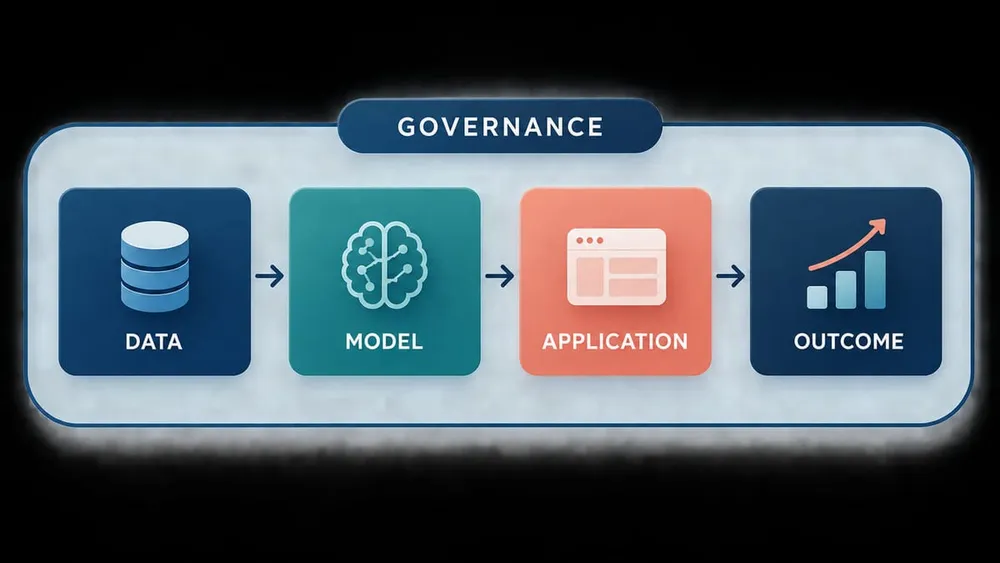
A practical four-layer view
- Data: examples, documents, images, events or measurements that provide the input.
- Model: the learned mathematical system that detects patterns or predicts an output.
- Application: the website, workflow or business system that supplies context and uses the result.
- Governance: the people, controls and evidence that determine what the system may do and how its performance is checked.
Most business value comes from the whole system, not the model alone. A capable model connected to poor data, unclear processes or excessive permissions can still produce an unreliable outcome.
What AI can and cannot do
AI can help classify requests, extract information, forecast demand, recommend content, generate drafts, search large knowledge collections and assist with multi-step work. These are bounded capabilities. The model does not automatically know your current policies, private records or business intent. Those must be supplied through approved data, instructions, integrations and review.
AI output can sound confident without being correct. Treat fluency as a user-interface quality, not proof of truth. For important work, define the acceptable source data, validation checks and person accountable for the result.
Start with the job, not the label
Before buying an “AI-powered” tool, describe the job in ordinary language: the input, expected output, decision owner, failure cost and success measure. Then ask whether a rules-based workflow, analytics, machine learning, generative AI or a combination is the simplest fit.
Next in this series: Machine Learning, Deep Learning and Neural Networks.
What Is AI? Artificial Intelligence in Plain English FAQs
Sources Checked
These primary sources were reviewed on 2026-09-17.