
Embeddings, Vector Search and RAG Explained
Embeddings turn content into numerical vectors that capture useful relationships. Vector search compares those representations to find content with similar meaning. Retrieval-augmented generation, or RAG, uses that search step to place relevant information into a model's context before it answers.
Embeddings make meaning searchable
A traditional keyword search looks for matching terms. An embedding can place semantically related content near each other even when the wording differs. A query about “ending an agreement” may retrieve a passage headed “contract termination” because the representations are similar.
Embeddings are not readable facts and proximity is not proof. They are mathematical representations optimised for a task. Search quality still depends on the source content, chunking, metadata, model and ranking method.
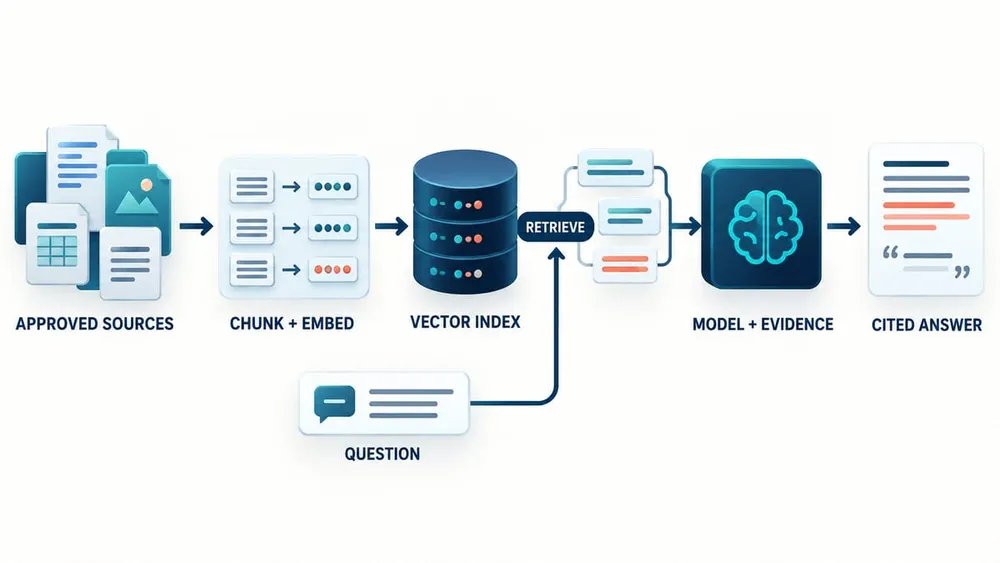
The basic RAG flow
- Collect approved documents or records.
- Split them into useful passages and preserve metadata such as source, owner, access level and review date.
- Create embeddings and store the vectors with their source references.
- Embed the user's question and retrieve likely relevant passages.
- Give those passages to the language model with instructions to answer from the evidence.
- Return citations or source links and record the retrieval result for evaluation.
RAG does not fix bad knowledge
If documents are outdated, duplicated or contradictory, retrieval can surface the wrong passage efficiently. Establish content owners, review dates, version rules and a deletion process. Preserve access controls during indexing and retrieval; a model must not receive a document merely because it is semantically relevant.
Measure retrieval separately from generation
First ask whether the correct source appeared in the retrieved set. Then ask whether the final answer used it accurately. This separation shows whether to improve the search index, ranking, prompt or model. A single thumbs-up score cannot locate the fault.
RAG is useful for policies, product documentation, service knowledge and other changing information. It is not a substitute for a transactional query when the answer must come from a live balance, booking, permission or order state.
Embeddings, Vector Search and RAG Explained FAQs
Sources Checked
These primary sources were reviewed on 2026-09-17.