
AI Search Reputation: How to Control What Google AI, ChatGPT and Copilot Say About Your Business
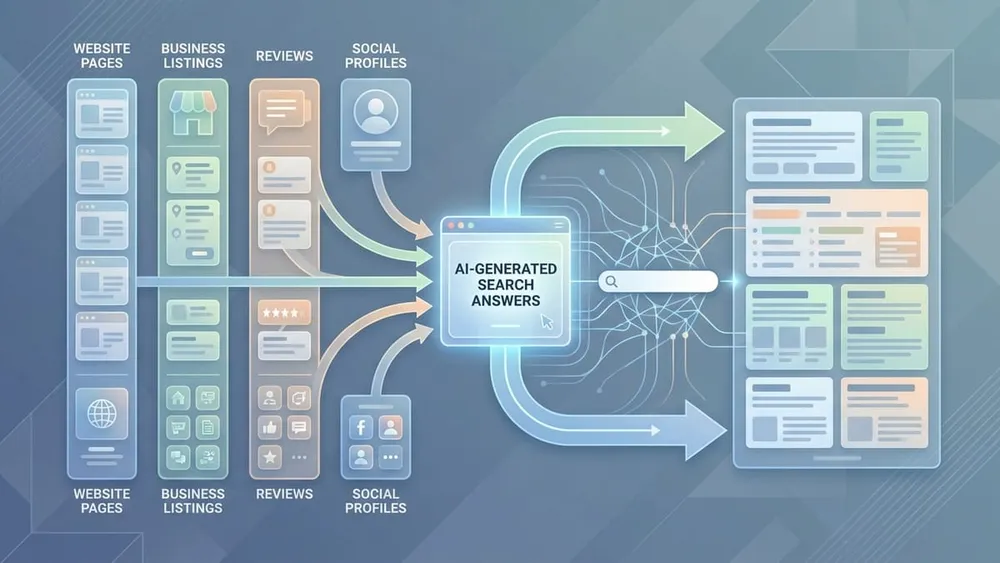
When people search for your business today, they may not only visit Google, scan ten blue links and click through to your website. They may ask Google AI Overviews, ChatGPT Search, Microsoft Copilot or another AI assistant to explain what your business does, compare you with competitors or recommend a provider.
That means your website is no longer just a brochure. It is becoming one of the main sources AI systems use to understand, describe and recommend your business.
If your website is unclear, outdated, technically weak or inconsistent with your other online profiles, AI tools may describe your business incorrectly. They may miss your best services, rely on old information, confuse your brand with another company or summarise your business in a way that does not reflect your real value.
This is where AI search reputation matters. AI search reputation is the practice of making sure AI-powered search tools can accurately understand, describe, cite and recommend your business. It is not about tricking AI. It is about making your website and online presence clear, trustworthy, structured and easy to verify.
What Is AI Search Reputation?
AI search reputation is how your business appears inside AI-generated search answers. It includes what AI tools say your business does, whether they mention you for relevant questions, whether they cite your website, whether they recommend your services, and whether your business details are accurate.
For example, a potential customer might ask:
- Who can build a website for a small business in Melbourne?
- Which agency can help migrate a WordPress website to Umbraco?
- Who provides SEO and AI search visibility services in Australia?
If your website is clear, helpful and technically accessible, AI systems have a better chance of understanding your business correctly. If your website is vague, outdated or missing important information, AI tools may rely on competitors, directories, review websites, forum posts, old articles or other third-party sources instead.
Why AI Search Reputation Matters Now
AI search is no longer just an experiment for website owners. Google has official guidance about AI features such as AI Overviews and AI Mode. Microsoft has introduced AI Performance reporting in Bing Webmaster Tools for visibility into citations across Microsoft Copilot, Bing and partner AI experiences. OpenAI also provides publisher guidance for ChatGPT Search, including OAI-SearchBot access and referral tracking from ChatGPT.
For small businesses, this matters because AI-generated answers may become the first impression a customer sees. If that first impression is wrong, incomplete or based on outdated sources, it can affect trust before the customer even visits your website.
AI Search Reputation Is Not Separate From SEO
A common mistake is thinking AI visibility is completely separate from SEO. It is not.
AI search systems still depend heavily on crawlable websites, indexed pages, helpful content, clear headings, structured data, trusted sources, consistent business information, page quality, internal links, external mentions and fresh content.
Google's guidance says website owners should continue focusing on effective SEO strategies because generative AI features in Search are rooted in Google's existing Search quality and ranking systems. Google also says there are no additional technical requirements or special AI schema needed for AI Overviews or AI Mode; the page must be indexed and eligible to appear in Search with a snippet.
So the best way to improve AI search reputation is not to create random AI-generated pages or chase shortcuts. The practical approach is to build a website that is genuinely useful, technically clean and easy to understand.
What Can Go Wrong If AI Does Not Understand Your Business?
AI tools can only work with the information they can access and interpret. If your website and external profiles are unclear, several problems can happen.
AI may describe your services incorrectly
If your website says "digital solutions" everywhere but does not clearly explain your actual services, AI may not know whether you build websites, provide SEO, offer cloud services, develop apps or only provide consulting. Vague language creates vague AI answers.
AI may miss important services
If you offer CMS migration, website accessibility, API integrations, ecommerce development or SEO audits but those services are buried inside one generic page, AI tools may not connect your business to those search queries. Each important service should have a clear page, clear headings and direct explanations.
AI may use outdated information
Old addresses, phone numbers, discontinued services, pricing references, team details, opening hours and technology claims can still influence summaries if they remain online. Update or redirect outdated pages, and clean up business listings that no longer match reality.
AI may confuse your business with another brand
If your business name is similar to another company, you need stronger entity signals. Your website should clearly show your business name, location, service areas, industries, core services, technology stack, contact details, social profiles and consistent descriptions across platforms.
AI may not cite your website
AI tools often prefer clear, authoritative and well-structured sources. If your website is thin, slow, blocked by crawlers or missing structured content, directories, competitors, reviews or forums may shape the answer more than your own website.
What AI Systems Need to Understand
Before you optimise for citations, make the basic identity, service and trust signals obvious across your website and external profiles.
Business Identity
Name, location, service areas, contact details, social profiles and ownership signals should be consistent.
Service Relevance
Dedicated service pages should explain what you do, who it is for, what is included and what outcomes clients can expect.
Technical Access
Important pages should be crawlable, indexable, internally linked, mobile usable and available as readable text.
Structured Context
Schema should describe visible content such as the organisation, services, articles, FAQs, breadcrumbs and local details.
Proof
Case studies, examples, reviews, credentials, author details and source links make claims easier to verify.
Monitoring
Repeat prompt testing, Search Console, Bing Webmaster Tools, analytics and server logs help reveal what is changing.
How Google AI, ChatGPT and Copilot Understand Your Business
Different AI search systems work differently, but most need reliable information from the web. The exact answer a user sees can vary by query, location, timing, platform and available sources, so think in terms of improving the quality and consistency of the source material.
Google AI Overviews and AI Mode
Google's AI search features are part of Google Search. Google says SEO fundamentals remain relevant for AI Overviews and AI Mode, including crawlability, indexability, useful content, page experience, textual content, internal links, high-quality media and structured data that matches visible text.
This means your website should still focus on clear page titles, helpful content, correct indexing, fast page loading, mobile usability, structured data, strong internal linking and descriptive images or videos where they help users.
ChatGPT Search
OpenAI says public websites can appear in ChatGPT Search, but there is no way to guarantee top placement. OpenAI's publisher guidance says sites should not block OAI-SearchBot if they want their content to be discoverable, surfaced, cited and linked in ChatGPT Search. It also says publishers can track ChatGPT referral traffic in analytics because ChatGPT includes utm_source=chatgpt.com in referral URLs.
For businesses, this means your website should not accidentally block important AI search crawlers if your goal is to appear in AI-powered answers. Search crawling and model training can be controlled separately, so decide your policy deliberately rather than copying a generic robots.txt file.
Microsoft Copilot and Bing
Microsoft's Bing Webmaster Tools AI Performance report shows how publisher content appears across Microsoft Copilot, AI-generated summaries in Bing and select partner integrations. The report includes citation activity, cited URLs, visibility trends and related query information for supported Microsoft AI experiences.
This is useful because businesses can begin to understand which pages are being used in AI answers and which topics trigger citations. It does not measure every AI platform, but it is a practical signal to include in your monitoring process.
How to Improve Your AI Search Reputation
1. Make your business description clear and consistent
Your website should explain your business in simple, direct language. A weak description sounds like this: "We provide innovative digital transformation solutions for modern brands." A stronger description sounds like this: "VaniTech is an Australian digital technology company that helps businesses build websites, implement CMS platforms, improve SEO, integrate systems and deliver cloud-based digital products."
The stronger version tells people and AI systems who the company is, where it operates, what it does, who it helps and what services it should be associated with.
Keep this description consistent across the homepage, about page, service pages, footer, contact page, Google Business Profile, Bing Places, LinkedIn, directory listings, schema markup and social profiles.
2. Create dedicated pages for each core service
AI search tools need clear content to understand what your business offers. If all services are listed on one general page, AI may struggle to connect your business with specific customer questions.
A digital agency may need separate pages for small business websites, CMS development, Umbraco development, Contentful development, Contentstack development, ecommerce development, API integrations, SEO services, AI search visibility, accessibility audits, performance optimisation, hosting and support.
Each service page should answer what the service is, who it is for, what problems it solves, what is included, what technologies are used, what the process looks like, what outcome the client can expect, why the provider is qualified and how to get started.
3. Use structured data
Structured data gives search engines explicit clues about your content. Google explains that structured data can help classify page content and make it eligible for rich search features, but it must represent visible content and does not guarantee a rich result.
For AI search reputation, useful schema types can include Organization, LocalBusiness, WebSite, WebPage, Service, Article, BlogPosting, FAQPage, BreadcrumbList, Person and compliant Review markup where appropriate.
Structured data should always match visible page content. Do not add fake schema, hidden claims or review markup that users cannot see.
4. Build strong topic clusters
AI systems are more likely to understand your expertise when your website covers a topic in depth. Instead of publishing one article about AI search, create a cluster around a core service page such as AI Search Visibility Services, then publish supporting articles about ChatGPT Search visibility, Google AI Overviews readiness, schema, local SEO, monitoring and AI search checklists.
Each article should link back to the main service page and to related articles. This helps users navigate the topic and gives search systems clearer relationships between pages.
5. Answer real customer questions
AI search is question-driven. People ask full questions, not only keywords. Your website should answer questions such as what the business does, whether it serves their location, whether it works with small businesses, what platforms it uses, what the process looks like, what affects cost and what makes the provider different.
Google recommends creating helpful, reliable, people-first content rather than content made primarily to manipulate rankings. The best content for AI visibility is usually the same content that helps a real customer make a decision.

Make Accurate Summaries Easy
AI systems summarise information. Use clear definitions, direct answer paragraphs, service-specific headings, proof, update dates and internal links so the summary has less room to drift.
6. Add proof, experience and specific examples
Generic content is easy to ignore. Specific content is easier to trust. Add case studies, project examples, before-and-after improvements, screenshots, diagrams, technology stacks, migration checklists, accessibility findings, performance results, client scenarios, implementation steps and lessons learned.
Instead of saying, "We improve website performance," explain that you review Core Web Vitals, image weight, JavaScript loading, hosting configuration, caching, frontend architecture and CMS rendering patterns to identify why a website is slow and what should be fixed first.
7. Keep content updated
AI tools may rely on old information if your current website is not clear or fresh. Review service descriptions, technology versions, pricing pages, team profiles, case studies, blog articles, FAQs, schema markup, internal links, redirects, sitemap entries and business listings.
When you update content, update the visible last updated date where appropriate and keep dateModified accurate in schema.
8. Make sure AI crawlers can access your website
Review your robots.txt, meta robots tags, X-Robots-Tag headers, CDN bot settings, firewall rules, JavaScript rendering, authentication restrictions, sitemap accessibility and canonical tags.
If your business wants visibility in ChatGPT Search, check that relevant search crawlers are not accidentally blocked. A simple policy might allow search crawlers while making a separate decision about model-training crawlers:
User-agent: OAI-SearchBot
Allow: /

User-agent: Googlebot
Allow: /

User-agent: Bingbot
Allow: /

Sitemap: https://www.example.com/sitemap.xml
Some businesses may choose to allow AI search crawlers but block training crawlers. That decision depends on content strategy, legal position and risk preference.
9. Improve local SEO signals
For local businesses, AI search reputation is closely connected to local SEO. Make sure your business information is consistent across Google Business Profile, Bing Places, Apple Business Connect, LinkedIn, local directories, industry directories, review platforms, the website footer, the contact page and schema markup.
If you serve a specific region, say it clearly. For example: "VaniTech provides website development, CMS implementation, SEO and AI search visibility services for businesses in Melbourne and across Australia." This is clearer than "We help businesses everywhere grow online."
10. Optimise images and videos
AI search is not only text-based. Google advises website owners to support textual content with high-quality images and videos when relevant. Use descriptive file names, meaningful alt text, compressed modern image formats, captions where useful and transcripts for videos. Avoid putting important text only inside images.
11. Monitor what AI tools say about your business
You cannot control every AI answer, but you can monitor patterns. Create a list of prompts to test monthly, such as:
- What does [business name] do?
- Is [business name] a good web development agency?
- Who provides website development services in Melbourne?
- Who can help migrate from WordPress to Umbraco in Australia?
- Which agencies help with CMS implementation?
- What companies provide AI search visibility services?
- Compare [business name] with other web development agencies.
- What services does [business name] offer?
Record whether your business appears, how it is described, whether your website is cited, whether competitors appear, whether the answer is accurate and whether outdated information appears.
12. Use Search Console, Bing Webmaster Tools and analytics
AI search visibility should be measured where possible. Use Google Search Console, Bing Webmaster Tools, Bing AI Performance, Google Analytics, server logs, referral tracking, rank tracking tools and manual AI prompt testing.
Important metrics include organic impressions, organic clicks, branded search growth, AI referral traffic, cited pages, grounding queries, service page visibility, conversions from informational pages and crawl activity from AI search bots. AI visibility will not always look like traditional SEO traffic. Sometimes the value is brand awareness, trust and inclusion in a customer's shortlist.
13. Create content that AI can summarise accurately
Use clear headings, short definitions, direct answer paragraphs, summary boxes, FAQ sections, tables, bullet points, examples, internal links, author details, updated dates and consistent terminology. Avoid vague claims, exaggerated marketing language, keyword stuffing, hidden text, duplicate pages, outdated information, unsupported claims and thin AI-generated content.
14. Build trust beyond your website
Your website should be the main source of truth, but AI tools may also consider information from other places. Strengthen external trust signals through Google Business Profile, LinkedIn, industry directories, partner listings, client testimonials, case studies, review platforms, guest articles, social profiles, professional profiles and local business citations.
15. Review and clean up outdated or inconsistent data
AI reputation issues often happen because old information is still available somewhere online. Review old service pages, landing pages, blog posts, PDFs, directory listings, social profiles, pricing pages, duplicate business profiles, staff pages and event pages. Redirect or update anything that could confuse customers or AI systems.
AI Search Reputation Checklist
- Homepage clearly explains who you are, what you do and where you operate.
- Each major service has its own page.
- Service pages answer real customer questions.
- Business name, address and contact details are consistent.
- Google Business Profile and Bing Places are accurate.
- Website is crawlable and indexable.
- Sitemap is submitted to Google and Bing.
- Important AI search crawlers are not accidentally blocked.
- Structured data is added to important pages.
- Articles include author, date published and date modified.
- Content is updated regularly.
- Internal links connect related topics.
- Images have descriptive file names and alt text.
- Website loads quickly on mobile.
- Pages are accessible and easy to read.
- Case studies and examples are published.
- FAQs answer real search questions.
- AI search prompts are tested monthly.
- ChatGPT referral traffic is tracked where possible.
- Bing AI Performance is reviewed where available.
- Old or duplicate business listings are cleaned up.
Recommended Implementation for the VaniTech Website
VaniTech already has a strong foundation. The website clearly describes the company as an Australian digital technology business specialising in websites, CMS, ecommerce, cloud architecture, search visibility and digital product delivery. It also has SEO, schema, AEO and GEO service positioning, which connects traditional search foundations with answer engine and generative engine visibility.
To make the website follow the recommendations in this article even more strongly, VaniTech should prioritise the following improvements.
Create a dedicated AI Search Reputation service page
A future /services/ai-search-reputation/ page should explain AI search visibility audits, AI search reputation review, Google AI Overviews readiness, ChatGPT Search visibility, Microsoft Copilot visibility, structured data and schema, content clarity, technical crawlability, local SEO consistency, AI answer monitoring and monthly reporting.
Create a dedicated article cluster
Recommended supporting articles include What Is AI Search Reputation, How to Make Your Website Visible in ChatGPT Search, How to Make Your Website Visible in Google AI Overviews, How Schema Helps AI Understand Your Business, AI Search Checklist for Small Businesses, Local SEO in the Age of AI Search and How to Monitor What AI Says About Your Business.
Add schema to core pages
Use Organization on the homepage, LocalBusiness where local context is relevant, Service on service pages, Article or BlogPosting on articles, FAQPage on FAQ sections, BreadcrumbList across the site and Person for author or leadership profiles where used.
Strengthen internal links
This article should connect naturally to SEO, Schema, AEO and GEO Services, CMS Services, Umbraco Development Services, Contentful Development Services, Contentstack Development Services, Small Business Website Services and the contact page.
Add a monthly AI search monitoring process
Every month, VaniTech should test prompts such as "What does VaniTech do?", "Who provides AI search visibility services in Australia?", "Who can help with Umbraco migration in Melbourne?", "Which company can help make my website visible in ChatGPT?" and "Who provides CMS migration and SEO services in Australia?" The results should guide service-page updates, schema improvements, internal links and external profile cleanup.
Conclusion
AI search reputation is becoming an important part of digital visibility. Customers increasingly use AI-powered search tools to compare businesses, ask for recommendations and understand services before making contact. If your business information is unclear or inconsistent, AI systems may describe your company poorly or ignore it completely.
The best response is not to chase shortcuts. The best response is to make your website the clearest, most useful and most trustworthy source of information about your business. For businesses, AI search reputation is now part of brand reputation. Your website should not only look good to people. It should also help search engines and AI tools understand exactly who you are, what you do and why customers should trust you.
AI Search Reputation FAQs
Direct answers to common questions about improving how AI-powered search tools describe, cite and recommend a business.
Sources Checked
- Google Search Central - AI Features and Your Website
- Google Search Central - Optimizing Your Website for Generative AI Features on Google Search
- Google Search Central - General Structured Data Guidelines
- Google Search Central - Creating Helpful, Reliable, People-First Content
- OpenAI Help Center - Publishers and Developers FAQ
- OpenAI Help Center - ChatGPT Search
- Microsoft Bing Webmaster Blog - Introducing AI Performance in Bing Webmaster Tools
- Google Search Console Help - Generative AI Performance Report
Want to Know How AI Tools Describe Your Business?
VaniTech can review your website, structured data, content, local SEO and AI search visibility to identify what needs to be improved.