
Contentful Development Services
Design, build, migrate, and support a Contentful platform that editors enjoy using and developers can scale with confidence.
Contentful Development Services
Contentful is powerful, but the real value comes from how it is modelled, connected, governed, and handed over to your team.
Vanitech helps businesses build practical Contentful platforms for websites, campaigns, content hubs, commerce experiences, and multi-channel digital products. We usually pair Contentful with Next.js, giving you a fast frontend, structured content, flexible publishing, strong SEO foundations, and room to grow.
Contentful has grown from a headless CMS into a composable content platform. It can support structured content models, reusable entries, media management, REST and GraphQL APIs, live preview, localization, release planning, role-based governance, app integrations, personalization, and AI-assisted content workflows.
Our job is to turn that feature set into a CMS your team can actually use. We plan the content model, page builder, preview experience, publishing process, frontend architecture, migration path, and integrations so Contentful fits the way your business creates and launches content.
Our Contentful Services
Contentful Website Development
We build Contentful websites that feel flexible for marketers and dependable for technical teams. The CMS should not become a maze of fields, and the frontend should not depend on fragile one-off templates.
Our typical Contentful website stack includes:
- Contentful for structured content management
- Next.js for fast, SEO-friendly frontend development
- Reusable React components mapped to CMS content types
- Content Delivery, Preview, Management, Images, and GraphQL APIs where appropriate
- Live preview and draft content review
- SEO metadata, routing, redirects, and schema support
- Responsive image handling and performance optimisation
- Webhook-based rebuilds, revalidation, and deployment workflows
- Editor-friendly content blocks, field labels, help text, and validation rules
The result is a website your team can update without waiting on developers for every content change, while still keeping brand, performance, accessibility, and search quality under control.

Contentful and Next.js Architecture
We use Next.js with Contentful to support static pages, dynamic content, preview mode, webhooks, revalidation, modular React components, structured metadata, and image optimisation. The result is a headless website that still feels practical for editors and reliable for developers.
Content Modelling and Page Building
A strong Contentful build starts with models that make sense to the people creating the content, not just the people reading the schema.
Contentful Content Modelling
Contentful is not page-first by default. It works best when content is broken into reusable, well-named, well-governed building blocks. We design content models that give editors enough freedom to move quickly without turning the CMS into an unstructured dumping ground.
We can create content models for:
- Pages and landing pages
- Service pages and product content
- Blog posts, resource centres, and case studies
- Authors, team members, testimonials, and FAQs
- Navigation, footer content, alerts, and global settings
- SEO metadata, Open Graph data, and schema configuration
- Campaign pages, location pages, and market-specific content
- Reusable content sections, references, and shared modules
We also set field validations, reference rules, naming conventions, help text, fallback behaviour, and publishing guidelines so the model stays clean after launch.
Contentful Component-Based Page Builder
For marketing websites, we often build a component-based page builder inside Contentful. Editors can assemble approved sections while the frontend keeps layout, spacing, accessibility, and visual consistency intact.
Example page components include:
- Hero banners
- Text and image sections
- Feature cards and icon grids
- Call-to-action sections
- FAQ accordions
- Logo carousels and testimonial blocks
- Pricing comparisons and service tables
- Case study highlights
- Blog and resource listings
- Related content modules
- Forms, statistics blocks, video blocks, and image galleries
Each content block is mapped to a reusable Next.js component, which keeps the site maintainable while still giving the content team useful creative control.
Contentful Studio and Visual Experience Building
When a project needs more visual control for marketers, we can help plan and implement Contentful Studio. Studio lets teams assemble digital experiences using registered design system components, reusable patterns, content binding, design tokens, roles, permissions, and the Experiences SDK.
We can help decide where Studio makes sense, which components should be available, what guardrails designers need, and how the frontend should support visual page assembly without weakening brand consistency or performance.

Contentful Migration Services
We help move content from WordPress, Drupal, Umbraco, Sitecore, Kentico, Optimizely, Contentstack, Hygraph, custom CMS platforms, and static HTML sites into Contentful. More importantly, we reshape the content so it works properly in a structured platform.
Migration, Governance, and Scale
For larger teams, Contentful becomes a content operations layer, not just a place to edit website pages.
Contentful Migration Services
A good CMS migration is not a copy-and-paste exercise. We audit your existing content, map it into a cleaner Contentful structure, preserve SEO value, and reduce the clutter that often accumulates in older platforms.
Our migration work can include:
- Content audits and migration planning
- Content type mapping and field normalisation
- Media and asset migration
- Redirect planning and URL preservation
- SEO metadata migration
- Content cleanup and deduplication
- Automated migration scripts where appropriate
- Manual review workflows for important pages
- QA across content, links, images, schema, and search indexing
Contentful Enterprise Architecture
Contentful can support much more than a single marketing site. We help organisations plan the bigger architecture: spaces, environments, locales, roles, permissions, workflows, integrations, deployment pipelines, and the boundaries between global and regional teams.
We can design Contentful architectures for:
- Multi-brand websites
- Multi-market and multi-language platforms
- Enterprise content hubs
- Campaign platforms and landing page systems
- Resource centres and knowledge libraries
- Product content websites
- Composable commerce experiences
- Digital experience platforms connected to CRM, ERP, PIM, search, analytics, or marketing systems
Environments, Launch, and Release Workflow
Contentful environments help teams test content model changes before production. Contentful Launch can also group entries and assets into releases, schedule publishing, and give teams a clearer calendar for coordinated campaigns.
We can configure:
- Development, staging, and production environments
- Environment aliases and safer promotion workflows
- Content model testing processes
- Release planning and scheduled publishing
- Preview environments and draft review
- Webhook-based frontend rebuilds and revalidation
- Deployment pipelines and rollback planning
- Clear approval paths for teams with multiple contributors
Localisation and Multi-Language Websites
Contentful supports localisation at the content model level, which makes it a strong choice for businesses managing multiple languages, countries, or regional variations. The challenge is deciding what should be shared, what should be local, and how editors should review translations before publishing.
Our localisation services include:
- Locale strategy and language fallback planning
- Multi-region content models
- Localized page routing and metadata
- Country-specific content rules
- Shared and regional content structures
- Translation workflow planning
- SEO hreflang implementation
- Localized sitemaps
- Editor training for multilingual content

Preview, Workflow, and Governance
A headless CMS should not make editors feel like they are publishing in the dark. We configure live preview, clear field labels, validation, publishing rules, user roles, approval workflows, and practical documentation so Contentful works for the whole team.
Editorial Experience, SEO, Apps, and Integrations
The strongest Contentful builds connect content quality with search visibility, team workflow, and the systems your business already relies on.
Live Preview and Editor Experience
Contentful live preview can show editors their draft changes in context as they work. With inspector mode, teams can jump from previewed page content back to the matching entry and field, which makes editing feel far more natural than guessing through raw entries.
We can configure live preview, preview URLs, draft data handling, field help text, validation, entry naming, content checklists, and editor documentation so your team can publish with confidence.
Contentful SEO Implementation
A headless CMS does not automatically deliver strong SEO. The quality comes from how the content model, frontend rendering, metadata, routing, redirects, performance, and schema are implemented.
Vanitech can implement Contentful SEO features such as:
- SEO title and meta description fields
- Open Graph and social sharing metadata
- Canonical URLs and robots controls
- Sitemap and robots.txt setup
- Redirect mapping
- SEO-friendly slugs and URL structures
- Breadcrumbs, internal linking, and heading structure
- Image alt text fields
- Schema markup for key page types
- Core Web Vitals optimisation
Contentful Schema and Structured Data
We can generate structured data from Contentful fields, let editors manage selected schema values, or build reusable schema configuration models for consistent markup across the site.
Schema options may include Organization, LocalBusiness, WebSite, WebPage, Article, BlogPosting, BreadcrumbList, FAQPage, Service, Product, Review, Person, Event, and CollectionPage markup.
Contentful Apps, Marketplace, and Custom Extensions
Contentful can be extended with marketplace apps or custom apps built for your team. This is useful when editors need better selectors, business-specific validation, external data, or a smoother workflow than standard fields can provide.
Vanitech can help build or configure Contentful apps for:
- Custom editor interfaces
- Product, location, or service selectors
- CRM, commerce, PIM, DAM, and analytics integrations
- Custom validation tools
- External data lookups
- Workflow helpers and dashboard widgets
- AI-assisted content tools and content quality checks
- Third-party API integrations
AI, Personalization, and Content Optimisation
Contentful now includes more tools for AI-assisted creation, translation, optimisation, and personalized experiences. We can help you use those features carefully: useful where they speed up content work, governed where brand, compliance, or accuracy matter.
Depending on your plan and goals, we can support AI actions, AI-generated content workflows, translation assistance, SEO suggestions, Contentful Personalization, audience segmentation, A/B testing, and integration with analytics or customer data platforms.
Contentful Integration Services
Contentful often works best as the content layer inside a composable digital stack. We can connect it with eCommerce platforms, PIM systems, CRM systems, ERP systems, marketing automation tools, analytics, search, forms, authentication providers, payment systems, newsletter platforms, internal APIs, and custom business applications.
Integration can be handled through APIs, webhooks, middleware, serverless functions, custom apps, or Next.js API routes depending on your requirements.
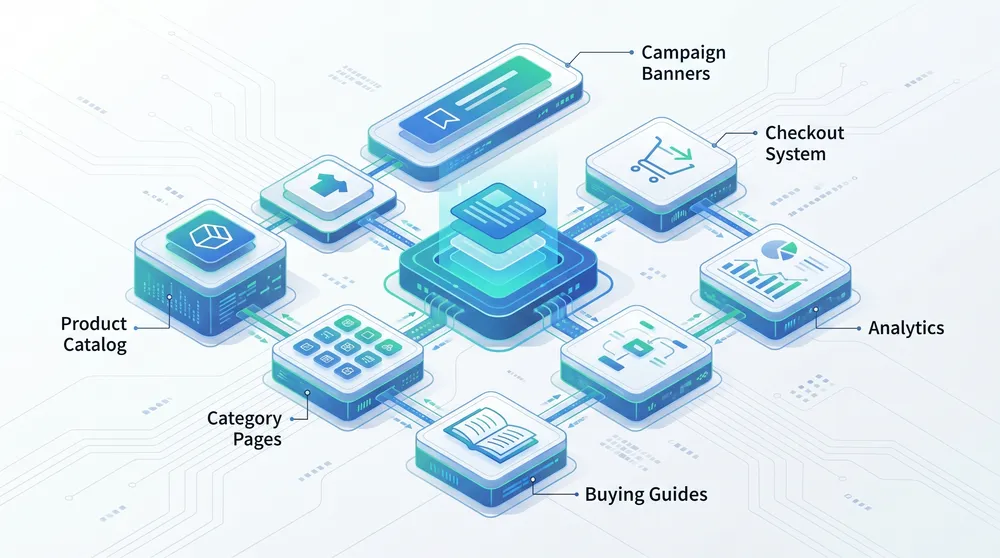
Contentful Commerce Content Architecture
For eCommerce, Contentful can manage campaigns, buying guides, brand pages, category content, promotional banners, and SEO product content while commerce systems handle pricing, inventory, cart, and checkout.
Content Platforms That Keep Growing
Beyond launch, Contentful should keep improving as your content, products, teams, and markets expand.
Blog, Resource Centre, and Content Hub Development
We can build complete Contentful-powered blogs, article hubs, help centres, case study libraries, and resource centres for SEO, education, lead generation, and customer support.
Features can include categories, tags, authors, featured articles, related content, search and filtering, reading time, table of contents, newsletter CTAs, article schema, social sharing metadata, previews, editorial workflow, SEO fields, scheduled publishing, downloads, and case study templates.
Contentful Design System Implementation
For a scalable website, the CMS model should line up with the design system. We connect Contentful content types to reusable React components, define content usage rules, and create a predictable set of patterns for editors.
We can help create component libraries, Next.js React components, CMS-to-component mapping, design tokens, responsive layouts, Storybook documentation, accessibility-friendly components, reusable layout patterns, CTA styles, and media handling rules.
Contentful Performance Optimisation
Contentful and Next.js can produce very fast websites, but performance still depends on implementation quality. We review the API strategy, caching, rendering, images, JavaScript, build process, and deployment setup.
Our performance services include API query optimisation, caching strategy, static generation, revalidation, webhook optimisation, image optimisation, lazy loading, bundle optimisation, Core Web Vitals improvement, CDN strategy, monitoring, diagnostics, and build performance review.
Contentful Support and Maintenance
Vanitech can support both new Contentful builds and existing implementations. We help teams fix issues, improve models, add new page components, maintain integrations, upgrade Next.js, improve SEO, refine performance, document workflows, and support editors after launch.
Why Choose Contentful with Next.js?
Contentful and Next.js are a strong combination for businesses that need structured content, flexible frontend design, strong performance, and room for future channels.
Key Benefits
Content operations at scale
Contentful is a good fit for teams that need structured content, multiple contributors, reusable assets, workflows, localisation, environments, and governance.
Flexible frontend delivery
With Next.js, your website is not limited by CMS templates. The frontend can be designed around your brand, accessibility needs, performance targets, and customer journey.
API-first content delivery
Contentful provides APIs for delivering, previewing, managing, and transforming content, including REST and GraphQL options.
Clearer release control
Environments, aliases, release planning, preview flows, and deployment pipelines help teams test changes before they affect the live website.
Multi-channel content reuse
Content can be reused across websites, landing pages, apps, campaigns, internal tools, and other digital products without rebuilding the same material again and again.
Extensible platform
Contentful's App Framework, marketplace ecosystem, Studio, Personalization, and AI-assisted workflows make it possible to keep expanding the platform as business needs change.
Our Contentful Delivery Process
1. Discovery and Platform Planning
We review your goals, current website, content types, editorial process, technical stack, SEO needs, integrations, and launch constraints.
2. Content Strategy and Modelling
We define content types, fields, relationships, reusable components, navigation models, metadata models, validation rules, and publishing guidelines.
3. Architecture Design
We plan the Next.js architecture, API usage, preview setup, caching, environments, deployment process, and integration points.
4. UX and Component Mapping
We map website sections to reusable React components and connect each component to the right Contentful content model.
5. Contentful Setup and Configuration
We configure spaces, content types, fields, validations, references, locales, roles, environments, workflows, media structures, and preview behaviour.
6. Next.js Frontend Development
We build responsive frontend templates and components with SEO handling, accessibility, performance, and maintainability in mind.
7. API and Integration Development
We connect Contentful with the website and any required third-party systems, such as search, CRM, commerce, forms, analytics, DAM, PIM, or internal APIs.
8. SEO, Schema, and Redirect Setup
We implement metadata, structured data, sitemap generation, canonical URLs, redirects, and SEO-friendly page structures.
9. Testing and QA
We test the editing experience, frontend behaviour, responsiveness, accessibility, SEO, performance, preview mode, integrations, and deployment process.
10. Launch and Ongoing Support
We support go-live, validate redirects and indexing, monitor launch behaviour, train editors, and keep improving the platform after release.
Ready to Build a Better Contentful Platform?
If you are planning a new Contentful build, moving away from another CMS, or trying to make an existing Contentful setup easier for editors and developers, Vanitech can help you shape the right architecture and delivery process.
Contact us or email us at info@vanitech.com.au to discuss your Contentful project requirements.

Make an appointment for a consultation