
Sitecore Search for AI Agents: Grounded RAG Guide
Sitecore published a new implementation recipe for using Sitecore Search to power AI agents on 12 October 2026. It addresses a common business problem: customers and staff increasingly expect a direct answer, but a general-purpose model can respond from memory, blend sources or sound certain when the website contains no evidence.
The new pattern keeps Sitecore Search responsible for retrieving governed business content and uses the language model only to compose an answer from accepted results. It adds refusal rules, citations, site and locale scoping, failure-safe retrieval and a separate relevance gate so weak matches do not become confident answers.
This guide is for business owners, digital and marketing managers, customer-service leaders, Sitecore teams and technology decision-makers considering a website assistant, internal knowledge helper or AI-enhanced search experience. It explains what is new, what a production architecture needs, how to test it and how a smaller team can run a bounded 30-day pilot.
Why this topic is trending now
Sitecore's new AI-agent and RAG implementation recipe moves the conversation beyond a generic chatbot. It provides a concrete architecture for turning an existing Sitecore Search index into three agent tools: content search, facet discovery and a curated question-and-answer capability.
The timing matters because many organisations already have approved service pages, product information, policies and support material in their CMS, yet their AI experiments often begin by copying content into a separate knowledge store. Sitecore's pattern makes the existing search index the retrieval layer and shows how to add orchestration and generation around it.
For potential VaniTech clients, the commercial question is no longer simply “Can we add an AI chatbot?” It is “Can we make it answer from content we own, prove which source it used, refuse when evidence is weak, protect private data and measure whether it reduces customer effort?”
Not every query needs an AI agent
Route each request to the simplest experience that can answer it accurately and economically.
Standard search
Use for keywords, browsing, filters and fast navigation. It is predictable, low latency and does not need a generative model.
Curated Q&A
Use for common direct questions with an editorially reviewed answer. It offers higher trust and lower generation risk.
Grounded AI agent
Use when a question needs retrieval across several documents, conversational follow-up or judgement about which tool to call.
Forced-retrieval RAG
Use for a focused answer panel where every request must retrieve content before the model writes a response.
Human hand-off
Use when content is missing, the answer affects an important decision, or the customer needs account-specific support.
No AI
Keep forms, payments, account changes and deterministic workflows conventional unless there is a clear, tested reason to add AI.
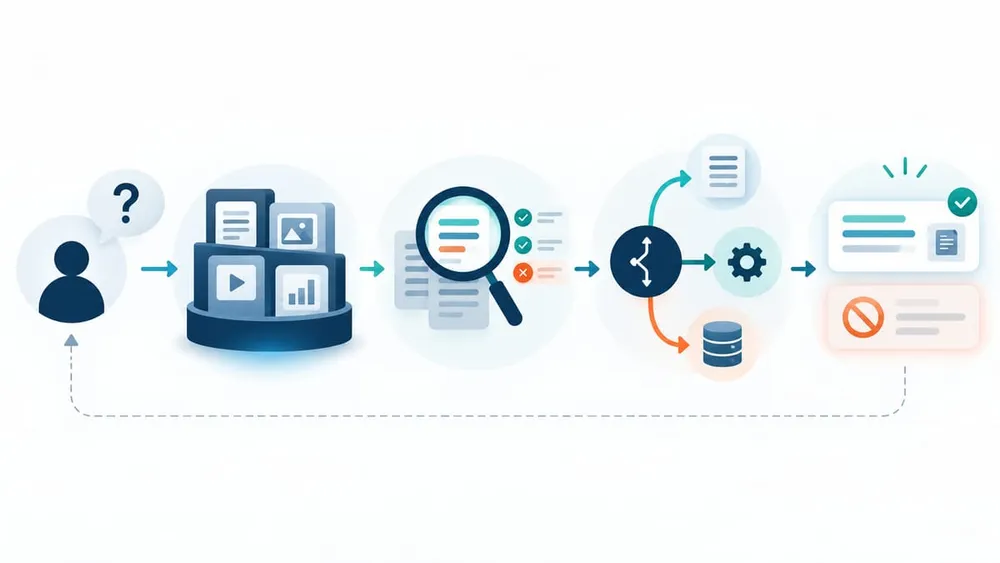
Separate retrieval, relevance, orchestration and generation
What Sitecore Search does—and what the model does
| Layer | Responsibility | Key control |
|---|---|---|
| Sitecore Search | Retrieve indexed pages, products, documents, facets and curated Q&A from approved sources | Source, site, entity, attribute and locale configuration |
| Relevance gate | Score candidate documents against the question and remove weak matches | Separate embedding model and a threshold tuned to real queries |
| Orchestration | Choose standard search, Q&A, a filtered search tool, follow-up retrieval or refusal | Explicit routing rules, tool limits and timeouts |
| Generation | Write a concise answer using only the accepted retrieved material | Grounding instructions, citations and no-evidence refusal |
This separation matters because fluency is not proof. A model can produce a polished answer even when retrieval is empty or unrelated. Sitecore's recipe says the agent must not answer about the organisation's content from general model knowledge and should say when the index has no relevant answer.
The business benefit is traceability. When each answer links to the approved source, content owners can correct the underlying page instead of trying to patch a hidden prompt.
Build the retrieval layer before the conversational layer
Start by confirming that the index contains the information people actually need. A grounded assistant cannot repair missing, conflicting or stale source content.
- Define the corpus. Choose one site, one audience and a bounded set of approved pages or documents.
- Index citation-ready fields. Every result should include a title, canonical URL, concise summary, locale, source and useful facets such as topic, content type or product category.
- Create plain retrieval functions. Test Sitecore Search calls without a model so configuration, filtering, timeouts and empty results are visible.
- Expose a small tool set. Sitecore recommends content search, valid-facet discovery and curated Q&A as a practical baseline.
- Fail safely. On missing configuration, a non-success response or timeout, return no evidence rather than a raw error or partial internal detail.
- Add citations at the data boundary. Carry the canonical title and URL with every accepted document so the model does not invent a source later.
Sitecore distinguishes search administrators, developers and business users. Keep those responsibilities explicit: administrators own index configuration, developers own the integration and business users refine relevance and content based on analytics and feedback.
Use curated Q&A as the higher-trust route
Sitecore Search's Questions and Answers capability can generate Q&A items from selected sources and attributes. Editors can also create answers manually, revise generated items or hide an item so it no longer appears.
That makes Q&A useful for stable, high-volume questions such as opening hours, eligibility, delivery rules, return conditions or service definitions. For a direct question, check the curated Q&A route before asking a generative agent to search several documents.
There are important boundaries:
- the capability currently supports English only;
- generated answers are only as complete as the indexed sources and attributes;
- source groups must be configured deliberately, especially across multiple brands or sites;
- editorial ownership is still required for review, correction, hiding and retirement;
- a no-match result must fall back to content search, a human path or a clear “I could not find that” response.
Treat the Q&A collection as a maintained product, not a one-off batch. Assign owners, review dates and a feedback loop from unsuccessful searches and escalations.
Add a relevance gate and an honest refusal
Search results are ranked, but a top result can still be a poor answer to the question. Sitecore's reference pattern adds a separate embedding model that compares the query with candidate documents, sorts them by similarity and drops anything below a tuned threshold before the generative model sees it.
Do not copy another organisation's threshold. Build a labelled evaluation set containing clear matches, partial matches, ambiguous questions and genuine no-answer cases. Measure where scores separate useful evidence from noise, then retest after major content, model or indexing changes.
The final instruction should be unambiguous: answer only from retrieved evidence, cite the supporting page and refuse when nothing relevant passes the gate. A useful refusal is specific and helpful, for example: “I could not find an approved answer in our support content. Try these topics or contact the service team.”
Refusal rate is not automatically a failure. During a pilot, it often reveals content gaps, indexing problems or questions that belong with a person rather than an AI system.
Protect site, language and permission boundaries
A Sitecore Search domain can contain content from several sources. If retrieval is not scoped, an assistant on one brand or regional site may cite another site's content with complete confidence. Pass the correct source IDs, site context and locale into every search tool—not only the visible search widget.
Language routing needs the same care. The visitor's resolved locale should control both the language searched and the language returned. Because Sitecore's curated Q&A capability currently supports English, non-English experiences need a planned fallback to ordinary content retrieval or standard search.
Do not put model-provider secrets or unrestricted retrieved context in browser code. Keep the agent and model call on the server, minimise the fields passed to the model and exclude draft, private, account-specific or internal material unless the use case has a tested permission-aware design.
The OAIC's AI privacy guidance recommends due diligence, human oversight and clear disclosure for public-facing AI systems that handle personal information. Tell users they are interacting with AI, explain the limits and provide a non-AI support path.
Test answers, refusals and failure modes
The Australian Government's AI Technical Standard recommends predefined quality, privacy, security and error-tolerance criteria, grounding with trusted data and testing in the target environment. Those principles are useful for private-sector teams even where the standard is not mandatory.
| Test group | What to verify | Pass evidence |
|---|---|---|
| Known answers | Correct answer, correct citation and no unsupported additions | Reviewer agrees with the source and answer |
| No-answer questions | Clear refusal without general-model improvisation | No unsupported factual claim |
| Weak and ambiguous matches | Relevance gate blocks noise or asks a clarifying question | Threshold and route behave as designed |
| Multi-site and locale | No cross-brand or wrong-language citation | Every answer stays in scope |
| Adversarial content | Retrieved instructions do not override system rules | Prompt-injection tests are contained |
| Retrieval outage | Experience degrades safely and does not expose raw errors | Refusal or conventional search fallback works |
| Privacy | No restricted fields, secrets or personal data leak to the model or user | Logs and payload reviews pass |
| Performance and cost | Latency and spend remain inside agreed limits | Measured percentile and per-answer cost meet targets |
Run the same evaluation set repeatedly. Generative systems are probabilistic, so one successful demonstration is not enough.
Measure business value and operational health
Do not judge the pilot by conversation volume alone. A busy assistant can still be wrong, slow or expensive.
- Answer quality: grounded-answer rate, citation correctness, unsupported-claim rate and reviewer acceptance.
- Coverage: answerable-question rate, refusal rate, missing-content themes and locale coverage.
- Customer outcome: self-service completion, escalation rate, repeat questions and satisfaction after the answer.
- Search quality: no-result rate, weak-match rate, Q&A hit rate and content freshness.
- Reliability: retrieval errors, timeouts, empty responses, fallback success and availability.
- Performance: first useful response time and total answer latency by route.
- Cost: model, embedding, search and monitoring cost per completed outcome.
- Risk: privacy incidents, boundary violations, unsafe outputs and successful adversarial tests.
The DTA's ongoing-monitoring guidance covers safety, reliability, security, costs, human oversight and unintended consequences. Assign each metric an owner, threshold and response action before launch.
A practical 30-day pilot for SMEs
Days 1–5: choose one bounded job
Select one audience and one content set, such as public support articles for a single service. Define the customer outcome, excluded topics, escalation path and measurable success threshold.
Days 6–10: prepare the source content
Remove contradictions, add owners and review dates, confirm canonical URLs and index citation-ready titles, summaries, locales and facets. Create or review curated Q&A for the most common direct questions.
Days 11–15: build retrieval and routing
Test Search calls without a model. Add source and locale scoping, timeouts, empty-result handling, citations and the route between standard search, Q&A and the agent.
Days 16–20: add the relevance gate and model
Build a labelled question set, tune the relevance threshold and enforce answer-only-from-evidence instructions. Add a clear refusal and human hand-off.
Days 21–25: test risk and operations
Run known, unknown, ambiguous, cross-site, multilingual, adversarial, outage and privacy tests. Instrument latency, cost, retrieval errors and source citations.
Days 26–30: release narrowly and review
Expose the pilot to a limited audience, review transcripts under an approved privacy process and compare outcomes with conventional search or support. Expand only after quality and risk thresholds are consistently met.
Questions to ask an implementation partner
- Which user problem needs an agent rather than better search, navigation or curated FAQs?
- What exact Sitecore sources, entities, fields, sites and locales can the assistant retrieve?
- How are draft, private, internal and account-specific records excluded?
- Can the assistant prove every business claim with a canonical source URL?
- How is the relevance threshold tuned and retested?
- What happens when Search, Q&A, the embedding service or the model is unavailable?
- How does the system detect and refuse prompt injection embedded in retrieved content?
- Where are prompts, retrieved passages, answers and feedback logged, and who can access them?
- How are personal information, retention, deletion and AI disclosure handled?
- Which metrics trigger rollback, content remediation or human review?
- What remains useful if the generative layer is removed?
A credible partner should be willing to recommend a conventional search improvement when it solves the problem more reliably and cheaply.
Questions business and digital teams are asking
Sources checked
- Sitecore Developer Portal — Using Sitecore Search to power AI agents
- Sitecore Documentation — Getting started with Sitecore Search
- Sitecore Documentation — The Questions and Answers capability
- Sitecore Documentation — Getting AI-powered questions and answers
- Sitecore Documentation — Integrating using REST APIs
- Australian Government DTA — AI Technical Standard, grounding
- Australian Government DTA — AI Technical Standard, monitoring
- OAIC — Privacy and commercially available AI products
- OWASP — Top 10 for LLM Applications 2025
Sources were accessed on 13 October 2026. Product capabilities and language support can change, so confirm current Sitecore documentation before implementation.