
Posted by Mahdi
Online Product Safety for Ecommerce: 2026 Checklist
A practical 2026 checklist for Australian ecommerce teams covering product data, supplier evidence, listing controls, complaints, recalls and reporting.
Australia’s product-safety debate has moved directly into ecommerce operations. On 1 September 2026, the ACCC said the framework needs reform and supported mandatory obligations for online marketplaces. Treasury will lead the reform work, so this is a policy direction—not a claim that new marketplace duties have already commenced.
The operational signal is still clear. The strengthened Australian Product Safety Pledge, published in August, sets measurable expectations around monitoring, listing removal, seller traceability, complaints, recalls and reporting. For an online retailer, the useful question is not simply “Are we compliant?” It is “Can our systems find the affected product, stop sales, identify customers and produce evidence quickly?”
This article provides practical technology guidance, not legal advice. Confirm obligations for your products and business model with an appropriate adviser.
Short response windows need reliable systems
marketplace commitments in the strengthened pledge
15
pledge target for regulator-requested listing removals
2 business days
pledge target for supply-chain information responses
5 business days
unsafe listings removed by signatories after safety-source checks in 2024–25
31,000+
What changed—and what has not
The ACCC’s 1 September response supports stronger mandatory obligations for online marketplaces, improved injury reporting and stronger penalties. Those reforms are still being developed. Do not describe the pledge’s timeframes as universal new law.
Existing duties still matter. ACCC guidance says online sellers at every stage of the supply chain must comply with applicable mandatory standards, avoid banned products, make required incident reports and recall unsafe products. If a supplier takes recall action, the ACCC must be told within two days. A death, serious injury or serious illness associated with a supplied consumer product can also trigger a two-day mandatory-reporting deadline.
The August pledge is voluntary, but it is valuable as a design benchmark. It shows the operating capabilities regulators expect mature marketplaces to develop: monitor safety sources, match more than exact SKUs, suspend listings, trace sellers and supply chains, handle consumer reports, contact affected buyers and measure outcomes.
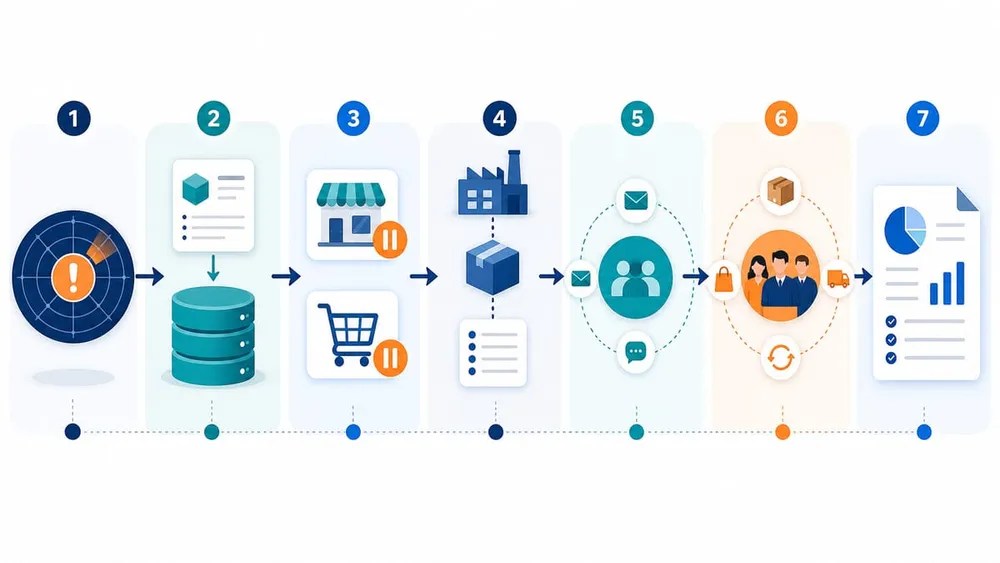
Product safety is a connected workflow
Four records every ecommerce team should be able to retrieve
A product page alone is not a product-safety system.
Product identity
SKU, GTIN where available, model, brand, variant, supplier product code, product images and the exact titles used across your website and marketplaces.
Safety evidence
Applicable standards, test certificates, declarations, warning copy, age grading, ingredients or materials, evidence owner, issue date and review date.
Market controls
Countries where the item may be sold, blocked regions, listing status, approval state, reason for suspension and the person who authorised release or removal.
Traceability
Manufacturer, importer and supplier details, purchase batches, fulfilment locations, marketplace seller identity, order lines and customers who received each affected item.
Build a workflow from signal to action
A practical workflow should work whether the first signal is an ACCC alert, an overseas recall database, a supplier email, a customer complaint or an internal quality check.
- Capture the signal. Create a case in a helpdesk, workflow tool or internal application. Record the source, time received, product clues, alleged hazard and owner.
- Match products and listings. Search by SKU or GTIN, then broaden the match using model, brand, titles, descriptions and images. The pledge explicitly recognises “matching” listings that share only some identifiers.
- Contain sales. Give authorised staff one control that can suspend the master product and propagate the block to the website, marketplace feeds, POS and advertising feeds. Preserve an audit trail; do not simply delete the record.
- Assess scope. Link the product to suppliers, batches, fulfilment records, orders and customers. Separate confirmed matches from possible matches that need review.
- Escalate and report. Route the case to the product-safety owner and legal adviser. Use timers for applicable two-day notifications and internal decision deadlines.
- Communicate and remedy. Prepare clear, accessible recall content, customer messages and refund, repair or replacement workflows. Track delivery failures and customer responses.
- Verify and learn. Check that the item cannot reappear under another feed or listing. Record root cause, update supplier controls and report outcome metrics.
Automation can move data and enforce timers. A person should still own safety assessment, regulator communication and the decision to restore a product.
Where the capability belongs in your technology stack
You do not need a new enterprise platform for every control. The design goal is one governed product identity with clear ownership across the systems you already use.
| System | Useful responsibility | Common failure to avoid |
|---|---|---|
| PIM, ERP or catalogue database | Master identifiers, supplier data, standards, certificates, warnings and market eligibility | Critical evidence stored only in email or shared folders |
| Shopify, BigCommerce or custom commerce | Sellable status, product-page warnings, channel publication and fast suspension | Blocking the website while marketplace or ad feeds remain live |
| CMS | Recall notices, safety guidance, accessible updates and reviewed customer-facing copy | Publishing a notice that is not linked to the affected product or orders |
| CRM, helpdesk or case system | Complaints, affected customers, communication history, ownership and timers | Complaints treated as isolated support tickets |
| Order and fulfilment systems | Batch, shipment, customer and remedy traceability | Knowing what was sold but not which customer received which variant |
| Reporting layer | Open cases, removal time, notification coverage, repeat listings and corrective actions | Producing metrics manually after an incident |
For a small catalogue, these controls may be disciplined fields, permissions and checklists. For a marketplace or high-volume retailer, APIs, event queues, similarity matching and automated channel suppression may be justified. Scale the mechanism to the risk, not to the fashion of the tool.
A 30-day readiness plan for SMEs
Week 1: inventory and ownership
- Name the person who owns product-safety cases and a backup.
- List the systems that hold products, supplier evidence, orders, complaints and customer contacts.
- Identify product categories subject to mandatory standards, bans or specialist regulators.
- Subscribe to relevant ACCC Product Safety alerts.
Week 2: data and controls
- Add missing identifiers, supplier records, warnings and evidence-expiry fields.
- Test whether one product can be suspended across every sales and marketing channel.
- Restrict who can approve, publish, suspend and restore high-risk products.
Week 3: recall workflow
- Configure a case template with severity, owner, decision log and deadline timers.
- Create product-matching and affected-customer reports.
- Prepare accessible recall-page, email and refund templates without pre-filling legal conclusions.
Week 4: exercise and improve
- Run a tabletop exercise using one real SKU and a fictional safety alert.
- Measure time to contain listings, identify buyers and prepare evidence.
- Fix the slowest handoff, then document the revised process and review cadence.
Questions to ask your ecommerce or integration partner
- Which system is the source of truth for product identity and safety evidence?
- Can a safety hold propagate to the website, marketplaces, POS and product feeds?
- Can we find every order and customer linked to a product, model, variant or batch?
- How are complaints classified and escalated when they mention injury, overheating, choking, contamination or another safety concern?
- Are permissions, approvals and product-status changes logged?
- Can the workflow show who acted, what changed, which messages were sent and whether they were delivered?
- What happens when an integration fails during a takedown or recall?
- How do we prevent a blocked item returning through a supplier feed or a slightly different listing?
The best answer is demonstrable. Ask for a test in a non-production environment, an example audit record and evidence that failure paths are monitored.
Ecommerce product-safety FAQs
Connect product data, commerce and customer operations
Sources Checked
- ACCC: Stronger product safety rules needed, including for online marketplaces (1 September 2026)
- ACCC: Australian Product Safety Pledge 2026 (August 2026)
- ACCC Product Safety: How to sell safe products online
- ACCC Product Safety: Recall an unsafe product
- ACCC Product Safety: Make a mandatory report
- ACCC Product Safety: Developing a compliance program
- ACCC: Online marketplaces pledge to do more to protect consumers from unsafe products (22 June 2026)