
Posted by Mahdi
Google August 2026 Spam Update: Website Checks for SMEs
A practical website audit checklist for small businesses after Google's August 2026 spam update, covering content quality, AI pages, backlinks, technical SEO, and Search Console diagnosis.
If your Google traffic changed suddenly this month, your website may not be broken. Google completed its August 2026 spam update on 21 August 2026, after the rollout began on 18 August 2026. For small businesses, the useful response is not panic. It is a calm audit of whether your website is genuinely helping customers or leaning on SEO shortcuts that Google's spam systems are designed to discount.
The update applied globally and to all languages, and it affected Google's ranking systems. Google has not named one single target such as AI content or backlinks, so businesses should avoid treating the update as a one-issue event. Review the full pattern: content quality, scaled pages, links, hidden or doorway content, hacked pages, technical accessibility, and what any outsourced SEO provider has done on your behalf.
The good news is practical: if your website has useful service pages, original business knowledge, clean technical foundations, and honest marketing, this is mostly a reminder to keep standards high. If you have old thin pages, copied descriptions, mass-produced local pages, or unclear link building, now is a good time to clean them up.
What to Check First
Start with the areas most likely to create ranking risk for small and medium businesses.
Scaled Content
Look for many near-identical pages, repetitive AI articles, copied supplier descriptions, keyword-only posts, or thin pages created mainly to rank.
AI Content Quality
AI-assisted content is not automatically spam. The issue is whether the page is original, useful, reviewed, accurate, and written for people rather than rankings.
Outsourced SEO
Ask what has been created, changed, linked, redirected, automated, or published on your behalf. Small businesses often inherit risk they never saw.
Backlink Patterns
Review paid links, low-quality directories, guest posts with unnatural anchor text, link exchanges, automated links, and sitewide footer links.
Doorway Pages
Check location pages, service variants, and duplicate microsites that funnel users to the same destination without adding local or service-specific value.
Technical Health
Confirm Google can crawl important content, pages are indexable, canonicals are correct, redirects are clean, and no hidden or hacked content exists.
What Actually Happened
Google's Search Status Dashboard lists the August 2026 spam update as an incident affecting ranking. It began on 18 August 2026 at 09:27 Pacific time and ended on 21 August 2026 at 01:49 Pacific time. Google's update note said the release applied globally and to all languages.
Google's spam update guidance explains that spam updates are notable improvements to its automated spam-detection systems, including SpamBrain. Sites that violate Google's spam policies may rank lower or not appear in results at all. Google also says improvement can take time, because automated systems need to learn over a period of months that a site is complying with spam policies.
Search Engine Land reported that the August rollout took about two and a half days and described it as the third Google spam update announced in 2026, after earlier March and June spam updates. That context matters for business owners because Google is continuing to refine spam detection through the year, not running a one-off cleanup.
| Checkpoint | What to know | Business response |
|---|---|---|
| 18 August 2026 | Rollout began and affected ranking globally across languages. | Mark this date in Search Console and analytics before interpreting traffic changes. |
| 21 August 2026 | Rollout was complete. | Compare affected pages and queries before and after the rollout window. |
| No single public target | Google did not say the update was only about links, AI, or one spam tactic. | Run a broad spam-policy and content-quality review instead of assuming one cause. |
| Recovery may take time | Google says substantive compliance improvements may be recognised over months. | Fix real issues and measure patiently rather than chasing a quick ranking switch. |

Do a Real Website Health Check
A ranking drop after a spam update is not proof of spam, but it is a strong signal to inspect the parts of your website that search engines and customers both depend on.
Six Risk Areas SMEs Should Review
Use Google's spam policies as the checklist, then translate each policy into practical website checks.
Scaled Pages
Find pages produced at volume with little original value, including AI-generated articles, template service pages, and keyword-only location pages.
Link Spam
Review paid links, low-quality directory submissions, excessive exchanges, automated link services, and unnatural anchors.
Doorways
Check whether city, suburb, industry, or service pages are genuinely useful or just variations leading to the same generic page.
Hidden Content
Look for hidden text, hidden links, CSS-obscured keyword blocks, and content shown to search engines but not real users.
Copied Content
Replace copied supplier descriptions, scraped articles, syndicated filler, and lightly rewritten competitor content with original business knowledge.
Hacked Pages
Search for injected pages, suspicious redirects, strange indexed URLs, unknown scripts, and Search Console security warnings.
AI-Generated Content Is Not Automatically Spam
Many businesses are now using AI to create first drafts, FAQs, service descriptions, social posts, product copy, and blog content. Google's public guidance does not ban AI content. The more useful distinction is quality and intent: was the page created to help a real audience, or mainly to manipulate rankings?
Google says appropriate use of AI or automation is not against its guidelines, but using automation to generate content primarily to manipulate search rankings violates its spam policies. That is a subtle but important difference. A human-reviewed AI draft that includes real examples, accurate service detail, useful comparisons, clear sourcing, and business expertise can be helpful. Hundreds of generic AI posts created because keywords looked easy are a different story.
What to Ask Your SEO Provider
If an external SEO provider manages your website, ask for a plain-English list of actions taken in the past 12 months. You want visibility into content created, pages removed or redirected, backlinks pursued, directories submitted to, schema added, AI tools used, location pages created, and any domains or microsites connected to your business.
- Which pages were created mainly for SEO, and what user need does each one satisfy?
- Have any paid, exchanged, automated, or guest-post links been built?
- Are there location pages, doorway pages, or near-duplicate landing pages?
- Was AI used, and who checked accuracy, originality, tone, and usefulness?
- Have any expired domains, redirects, or third-party subfolders been used?
- Are there Search Console manual actions, security issues, indexing warnings, or crawl problems?
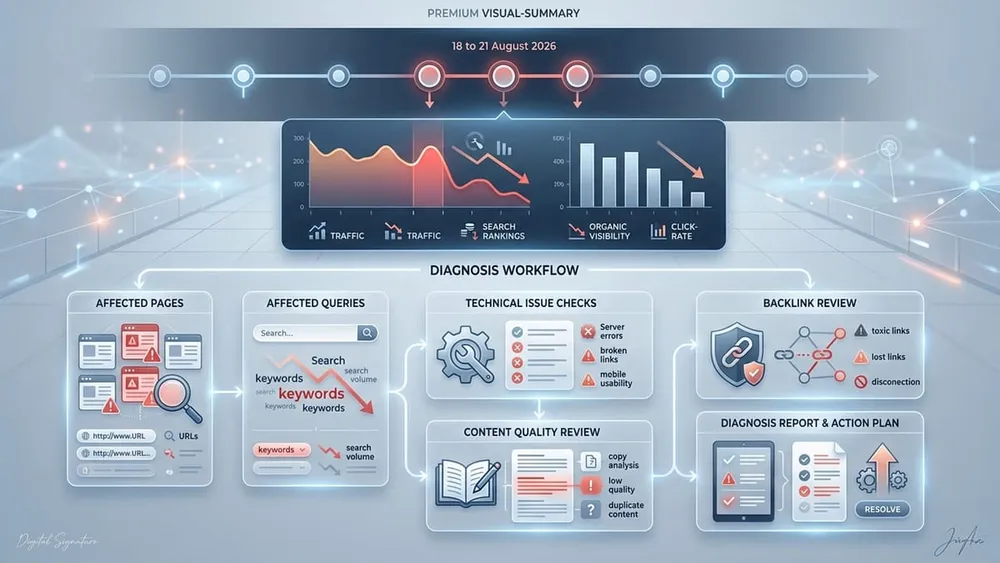
How to Diagnose a Ranking Drop Properly
Do not rewrite your entire website because traffic moved for two or three days. Algorithm rollouts can create short-term volatility, and your own business can also be affected by seasonality, competitor activity, tracking changes, ads, website releases, outages, and reporting delays.
Start in Google Search Console. The Performance report lets you view clicks, impressions, CTR, average position, queries, pages, countries, devices, search appearance, and dates. Compare the rollout window around 18 to 21 August 2026 against a normal recent period. Then identify whether the drop is site-wide or concentrated in specific pages, queries, services, countries, or devices.
| Signal | What it suggests | What to check next |
|---|---|---|
| Only a few pages dropped | The issue may be content quality, intent mismatch, technical change, or page-level competition. | Review each page against search intent, helpfulness, links, indexing, schema, and recent edits. |
| Many similar pages dropped | Scaled, duplicate, thin, or doorway-style content may be exposed. | Audit templates, suburb pages, AI articles, product descriptions, and internal linking. |
| Rankings dropped but impressions stayed steady | Competitors or result layout may have changed, or the page may be less preferred. | Compare current search results, titles, snippets, page quality, and content completeness. |
| Clicks dropped but rankings did not | CTR, search features, snippets, demand, or brand perception may be the problem. | Review titles, descriptions, rich results, AI results, seasonality, and query intent. |
| Search Console shows warnings | Manual action, security, indexing, or crawl issues may be involved. | Resolve the specific Search Console issue before making broad content changes. |
What to Improve First
Prioritise pages that matter commercially and show evidence of impact. For each page, improve the answer quality, remove filler, add real examples, update outdated facts, make service details specific, consolidate duplicates, fix broken links, improve internal links, and make the page easier for humans to use. Technical fixes help when they unblock crawling, indexing, rendering, page experience, or structured data accuracy, but there is rarely a magic technical switch for a spam update.
Common Questions After the August 2026 Spam Update
Short answers for business owners reviewing traffic changes after the rollout.
Practical 30-Day Action Plan
Week 1: Confirm the Pattern
Compare Search Console performance before, during, and after 18 to 21 August 2026. Export affected pages and queries. Check whether traffic changes line up with the update or with your own website releases, tracking changes, ads, campaigns, outages, or seasonality.
Week 2: Audit Risky Content
Review thin service pages, old blog posts, repeated local pages, copied product descriptions, AI-assisted articles, and pages with little original expertise. Improve useful pages. Consolidate duplicates. Remove or noindex pages that should not exist in search.
Week 3: Audit Links and Technical Health
Check backlink patterns, redirects, canonicals, sitemap inclusion, crawl errors, indexed surprises, hidden text, injected pages, page speed, mobile usability, structured data, and security warnings. Fix issues that prevent users and crawlers from accessing the right content.
Week 4: Document the New SEO Standard
Create a simple internal rule: every page must have a clear audience, a real customer purpose, original value, accurate details, review ownership, and a measurable next step. If an SEO tactic would be embarrassing to explain to a customer, it probably should not be part of the strategy.
Final Recommendation
The August 2026 spam update is a reminder to treat SEO as website quality work, not loophole hunting. Use Search Console to understand the pattern, review Google's spam policies, clean up low-value content, check outsourced SEO activity, and strengthen the pages that genuinely help customers choose your business.
For Australian SMEs, the strongest move is a focused SEO health check: content, technical SEO, backlinks, indexing, analytics, and AI-generated content governance in one review. That gives you a practical repair plan instead of a vague fear that Google has changed again.
Sources Checked
- Google Search Status Dashboard - August 2026 spam update
- Google Search Central - spam updates and your site
- Google Search Central - spam policies for Google web search
- Google Search Central Blog - guidance about AI-generated content
- Google Search Console Help - Performance report
- Google Search Console Help - about Search Console
- Search Engine Land - Google August 2026 spam update done rolling out
Get a Practical SEO Health Check
VaniTech can review your content, technical SEO, backlinks, Search Console data, and AI-generated pages so you know what to keep, fix, consolidate, or remove.