
Contentful GraphQL Limit: Prepare Before 9 October 2026
Audit Contentful GraphQL queries before the 9 October 2026 fragment-spread limit. Find risky callers, simplify queries, test and monitor rollout.
Contentful will enforce a maximum of 40,000 expanded fragment spreads per GraphQL request from 9 October 2026. Requests above the ceiling will return HTTP 400. Contentful says most applications will not need changes, but applications that generate GraphQL documents with extensive repetition across nested fragments are the ones to investigate now.
For an affected headless website, ecommerce storefront, mobile app or static build, the failure may appear far away from the query source: a page can stop rendering, a build can fail, preview can break, or an integration can begin returning incomplete experiences. The practical job is not to rewrite every query. It is to identify the small set of generated or deeply composed documents that could cross the new boundary and reduce their blast radius before enforcement.
This guide is for Australian business owners, digital and marketing leaders, development teams and technology decision-makers who use Contentful directly or rely on an agency, support partner or custom application that does.
Three facts to put on the delivery plan
The deadline is fixed, the affected pattern is specific, and existing limit checks are not a substitute.
9 October 2026
Contentful's enforcement date gives teams less than a month from the announcement to audit and remediate.
40,000 expansions
The API counts fragment usages after nested fragment references are resolved, not only the fragment names visible at the top level.
HTTP 400
A query above the limit will be rejected, so test failures and monitors need to treat this as a release-blocking condition.
What an expanded fragment spread means
Fragments are reusable groups of GraphQL fields. They help teams avoid duplicating the same field list across page types, components and applications. The risk emerges when fragments include other fragments and the same nested graph is referenced repeatedly. Contentful will evaluate the fragment usages after those nested references are resolved.
Imagine a page query that requests many modular content blocks. Each block fragment may include a shared image fragment, link fragment, metadata fragment and tracking fragment. A page-builder query generator may then repeat those blocks across unions, locales, navigation, recommendations or preview variants. The source document can look organised while the expanded graph becomes very large.
That distinction matters because three Contentful controls answer different questions:
| Control | What it measures | Typical failure |
|---|---|---|
| Expanded fragment spreads | Fragment usages after nested fragment references are resolved | HTTP 400 from 9 October when the request exceeds 40,000 |
| Query complexity | The maximum number of entries and assets the request can potentially return | TOO_COMPLEX_QUERY; current documentation describes an 11,000-entity ceiling |
| Query or payload size | The bytes sent in the query parameter or POST body | QUERY_TOO_BIG; Contentful documents an 8 KB ordinary limit |
Contentful states that the new fragment ceiling is independent of a space's query-complexity allowance. Automatic persisted queries can help eligible plans with payload size and network transfer, but persistence or minification should not be treated as proof that a deeply repeated fragment graph is safe. The executed document still needs to comply with the new expansion rule.
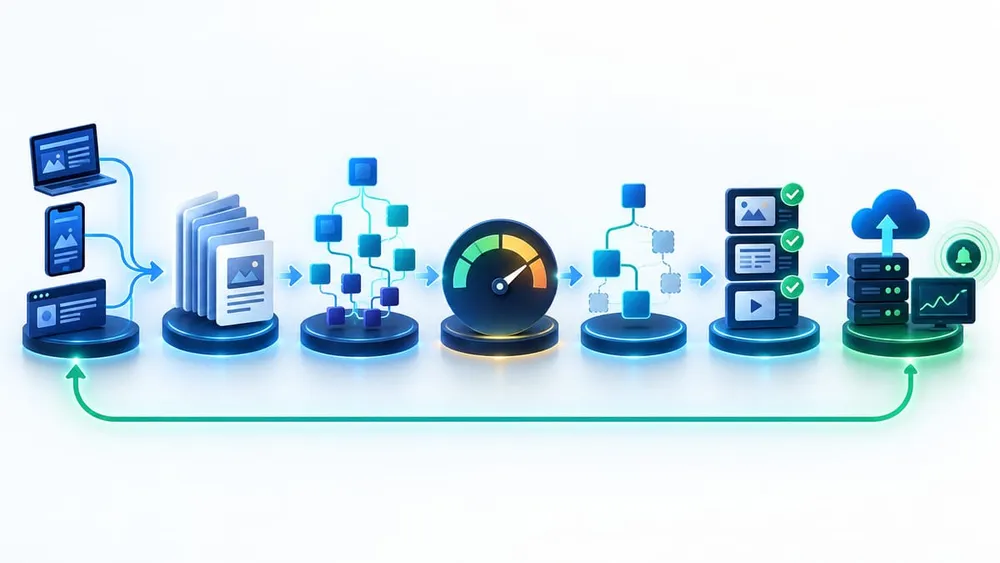
Trace every generated query from source to production
Start with a complete caller inventory
The highest-risk omission is testing the main website while forgetting another system that generates a different document. Build an inventory around deployed behaviour, not repository names.
| Caller | Queries to capture | Business failure to test |
|---|---|---|
| Production website | Home, landing pages, navigation, search, listings and complex page-builder routes | Blank pages, server errors, missing modules or stale fallback content |
| Preview and editor tools | Draft content, preview-specific fields, multi-locale views and deep linked entries | Editors cannot preview or approve content |
| Static or incremental builds | Route discovery, sitemap, page generation and revalidation queries | Deployments fail or published changes never reach the site |
| Mobile and kiosk apps | App-version-specific documents and persisted-query registries | Older clients fail after server-side enforcement |
| Ecommerce and personalisation | Product content, recommendations, campaigns and modular merchandising pages | Product detail or campaign experiences break during trade |
| Internal integrations | Feeds, exports, search indexing, analytics enrichment and reporting | Downstream systems silently stop receiving current content |
For each caller, record the repository and owner, framework or SDK, Contentful space and environment, delivery or preview endpoint, deployment route, query-generation step, monitoring location and rollback contact. If a former agency owns the build pipeline or query registry, treat access recovery as part of the migration rather than waiting for an incident.
Inspect the final document, not only source fragments
Many modern projects compose queries through code generation, page-builder unions, framework plugins or persisted-document pipelines. The file a developer edits may not be the document sent to Contentful. Capture the final operation after imports, interpolation and generation have completed.
- Export the operation catalogue. Collect every production and preview operation name, final document or persisted hash, owning application and environment.
- Expand the fragment graph in CI. Parse each final document, follow nested fragment references and count every occurrence with recursion safeguards. Keep the count beside the operation name and build commit.
- Fail below the vendor ceiling. Use an internal warning and failure threshold below 40,000 so later component additions do not push a query across the line without review.
- Test generated variants. Include routes, page types, locales, preview modes and feature flags that change the final operation.
- Retain evidence. Store the counts and representative API responses with the release so support teams can prove what was tested.
The exact counter depends on the project's GraphQL tooling, so the implementation should be validated against Contentful's definition. The useful control is deterministic: the same final document should produce the same expansion count locally, in CI and during release review.
Reduce risky queries without hiding the problem
If a document is close to or above the threshold, simplify the graph in ways that also improve maintainability.
- Split unrelated page concerns. Navigation, footer, recommendations and below-the-fold modules do not always need to be fetched in one operation.
- Remove duplicate fragment paths. Generated unions can request the same shared fragment through many branches even when a smaller common selection is sufficient.
- Limit page-builder breadth. Query the component types and fields a route can actually render instead of a universal fragment covering the whole content model.
- Load optional experiences separately. Personalisation, related content or large collections can use a second request when the customer journey allows it.
- Use explicit pagination and bounded collections. This primarily manages query complexity and response work, but it also keeps large all-purpose documents from accumulating unrelated concerns.
- Keep persisted-query registries current. When documents change, ensure deployed clients, server caches and registries agree on the new operation.
Do not merely rename fragments, remove whitespace or switch from POST to persisted execution. Those changes can reduce payload size without changing the expanded graph. The goal is fewer repeated fragment usages in the executed operation.
Test with representative Contentful data and environments
A query can pass against a thin developer environment and still fail or expose a different defect against production-shaped content. Test the document catalogue against a fresh, access-controlled copy or representative release environment where your plan and governance allow it.
| Test dimension | Minimum coverage | Evidence to keep |
|---|---|---|
| Operation structure | Every final generated production and preview document | Expansion count and CI threshold result |
| Content shape | Simple pages and the most deeply modular pages | Successful HTTP response and expected component rendering |
| Locales | Default locale, fallbacks and high-content regional variants | Page snapshots or structured response assertions |
| Delivery modes | Published delivery, preview and any persisted-query path | Status, error body and operation identifier |
| Build paths | Full build, incremental revalidation, sitemap and scheduled content | Clean build logs and post-publish verification |
| Failure behaviour | Deliberately rejected test operation in a safe environment | Alert fires with useful ownership and operation context |
Contentful documents environment aliases as a way to isolate changes, run regressions and promote or roll back a release. An alias rollback can help when a content-model release is faulty, but it does not remove the new platform limit. Keep an application rollback ready for query-code changes, and confirm that the previous release is itself compliant.
Reach the deadline without a rushed rewrite
Prioritise visibility first, then remediate the few operations that need it.
Week 1: inventory
Name every caller, owner, environment, query generator, registry and critical customer journey.
Week 2: measure
Capture final documents, count expanded fragment usage and rank operations by business impact and headroom.
Week 3: simplify
Split oversized concerns, reduce repeated branches, update persisted documents and complete regression testing.
Week 4: release
Deploy through the normal pipeline, verify production operations, enable alerts and retain rollback evidence.
Monitor the rejection as a distinct operational signal
Do not group every HTTP 400 response into a generic API-error total. Capture the structured Contentful error body, operation name or persisted hash, application, environment, release version, route and timestamp. Keep authentication failures, rate limiting, query-complexity failures and the new fragment-expansion rejection in separate alert categories so the on-call team reaches the correct runbook.
For organisations with Contentful Enterprise Observability, GraphQL logs can be delivered to supported cloud storage in near-real-time batches and analysed in tools such as Datadog, Splunk or Grafana. Other teams can instrument the application or server-side Contentful client, provided tokens and customer data are not written into logs.
Track at least:
- count and rate of Contentful GraphQL HTTP 400 responses by operation;
- top operations by expanded-fragment count and remaining headroom;
TOO_COMPLEX_QUERY,QUERY_TOO_BIG, authentication and HTTP 429 responses separately;- failed static builds, revalidations and preview requests;
- customer-facing render errors and fallback-content use after deployment.
Alert ownership is as important as collection. The message should identify the application team and the operation that failed, not only the Contentful endpoint.
Questions to ask your developer or support partner
- Which live websites, mobile apps, preview tools, builds and integrations call Contentful GraphQL?
- Can you show the final generated document and expanded-fragment count for every production operation?
- Which operations have the least headroom below 40,000, and what customer journeys depend on them?
- Does CI block new or changed queries before they reach the vendor ceiling?
- Have delivery, preview, locales, page-builder routes and persisted-query versions all been tested?
- What application rollback is available if a simplified query introduces missing content?
- Will production monitoring identify the rejected operation and responsible team?
- Who owns Contentful API-change review after 9 October?
A credible answer includes an inventory, reproducible counts, test evidence and named ownership. “Most Contentful sites are unaffected” is useful context, but it is not evidence about your deployed applications.
Sources checked
- Contentful: Upcoming Limit for Expanded GraphQL Fragment Spreads
- Contentful GraphQL Content API overview
- Contentful Automatic Persisted Queries documentation
- Contentful changelog: GraphQL API log streaming
- Contentful API errors reference
- Contentful environment-alias deployment guide
- Contentful API rate-limit response-header change