
Posted by Mahdi
Australian Privacy Reform 2026: Website Data Guide
Australia’s next privacy reform package has moved into a short, practical consultation window. On 31 August 2026, the Australian Government released exposure draft legislation covering roughly 40 proposals. Submissions close on 18 September 2026.
The proposed changes reach well beyond a privacy-policy page. They touch how a business collects information through forms, passes browsing data to advertising platforms, synchronises leads into a CRM, retains customer records, responds to deletion requests and manages a breach across vendors.
This article provides general technology and implementation guidance, not legal advice. The Bill is an exposure draft and remains subject to consultation and further government consideration. Check whether the Privacy Act covers your organisation and obtain legal advice on how current or future obligations apply.
Privacy reform is becoming an operational systems issue
proposals described in the consultation paper
~40
2026 consultation closing date
18 September
proposed regulator-notification period for an eligible breach
72 hours
current turnover threshold for many organisations, subject to exceptions
$3 million
What is proposed—and what is already good practice
The official consultation is not a declaration that every measure is law. The exposure draft proposes:
- a single fair and reasonable test for collecting, using and disclosing personal information;
- a definition of consent that is voluntary, informed, current, specific and unambiguous;
- stronger data-minimisation, security and breach-response requirements;
- clarified direct-marketing and opt-out rules;
- consent requirements for trading personal information, with proposed exceptions; and
- a right to erasure applying to defined large digital platforms, not every SME website.
Do not redesign a website around unfinalised wording. Do use the consultation as a reason to fix controls that are valuable now: collect less, explain more clearly, know where data goes, remove records you no longer need, limit vendor access and rehearse breach response.
Does this matter to small businesses?
The OAIC says most businesses with annual turnover of $3 million or less are not covered by the Privacy Act, but there are important exceptions. Health service providers, businesses that trade in personal information, TFN recipients, credit-related organisations, Commonwealth contractors, related bodies corporate and businesses that opt in can be covered in different circumstances. Privacy obligations can also arise through contracts, state rules, sector regulation or customer expectations. Confirm scope rather than assuming that “small” means exempt.
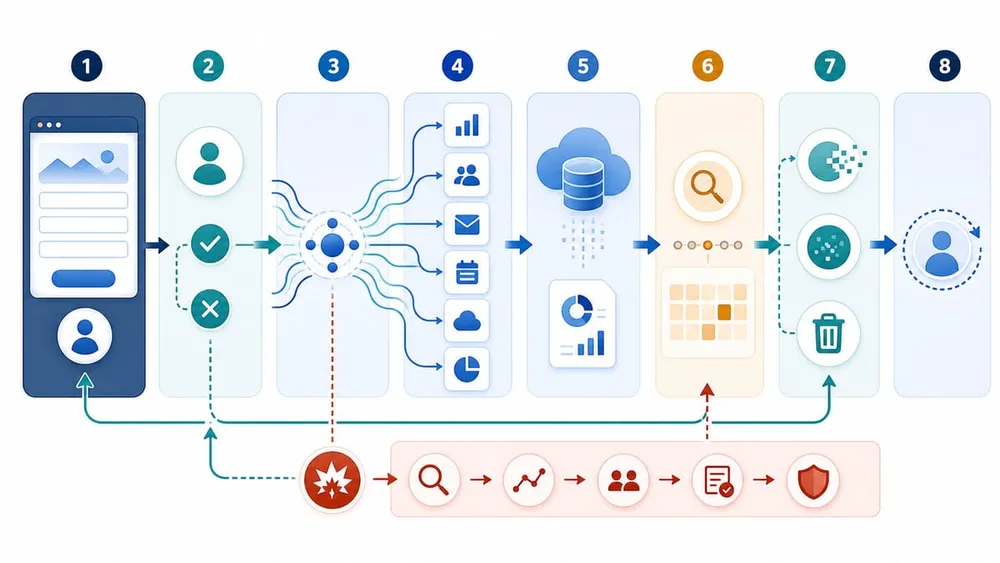
A website form is the start of a data journey
Four records to build before rewriting any notice
The public wording should come from verified system facts.
Collection points
List contact, quote, booking, account, checkout, support, survey and recruitment forms; chat tools; analytics events; cookies; pixels; device identifiers; uploaded files; and data inferred from behaviour.
Purposes and choices
Record why each field or event is needed, whether it is required or optional, what the person sees at collection, which choices are offered and how consent or opt-out evidence is stored.
Destinations and access
Map the CMS, CRM, marketing automation, advertising, payment, booking, analytics, support, cloud and reporting systems that receive the data, including vendor access and overseas processing.
Retention and response
Define the owner, retention trigger, deletion or de-identification method, backup treatment, legal hold, access controls, incident contacts and evidence that a request or response was completed.
Audit the website stack field by field
A generic list of vendors is not enough. Build a register at the level where a team can make a decision and verify a change.
| Question | Evidence to capture | Practical test |
|---|---|---|
| What is collected? | Field name, event, cookie, identifier, attachment or inferred attribute | Inspect the rendered page, network requests, tag manager and server logs. |
| Why is it needed? | Purpose, business owner and lawful basis or other justification to be confirmed | Remove a field in a test environment and see whether the service still works. |
| Where does it go? | Destination system, processor, region, API, webhook and downstream sync | Submit a unique test record and trace every copy. |
| What does the person see? | Collection notice, optional-field label, consent choice and opt-out path | Test as a new visitor on mobile with no prior cookies. |
| How long is it kept? | Retention trigger, duration, exception, archive and backup treatment | Find the oldest record and explain why it still exists. |
| Who can act? | Role, permission, vendor access and approval history | Review actual accounts rather than the intended access model. |
Start with the highest-risk flows: health or identity information, precise location, financial details, children’s data, recruitment records, behavioural advertising, customer portals and any integration that exports a broad customer profile.
Consent, cookies and pixels need a purpose—not just a banner
The consultation paper’s proposed consent definition is a useful design test: voluntary, informed, current, specific and unambiguous. It says bundled consent, deceptive interfaces and pre-ticked boxes are unlikely to satisfy parts of that definition.
The draft also treats direct marketing broadly. It describes targeted social advertising and online behavioural advertising based on personal information such as browsing history, and identifies disclosures of cookies or pixels in programmatic advertising as an example that may fall within the proposed concept of trading personal information.
For a website team, that creates five practical checks:
- Classify tags by purpose. Separate essential operation, measurement, personalisation, advertising and embedded third-party content.
- Control firing technically. A banner is ineffective if non-essential tags run before the visitor’s choice is applied.
- Keep choices specific. Avoid one switch that bundles unrelated marketing, profiling and partner disclosures.
- Store evidence. Record the consent version, categories selected, timestamp and identifier without collecting more data than necessary.
- Propagate withdrawal. An opt-out should update the browser state and relevant CRM, email, audience and advertising systems where technically and legally required.
Do not assume that installing a consent-management platform resolves the underlying question. The business still needs to decide which data use is necessary, expected, proportionate and accurately described.
Retention and deletion must work across connected systems
Current APP 11 guidance already says covered entities must take reasonable steps to secure personal information and destroy or de-identify it when no longer needed, subject to exceptions. The proposed reforms increase the attention on minimisation and erasure, but the exposure draft’s specific right to erasure is limited to defined large digital platforms.
For most SMEs, the immediate problem is simpler: records are copied into several tools and nobody owns the end of the lifecycle. A usable retention rule needs:
- a trigger, such as quote expiry, contract end, inactive-account date or resolved support case;
- a defined duration supported by business and legal requirements;
- a named owner and automated report or deletion job;
- documented exceptions for disputes, regulatory duties or legal holds;
- treatment for exports, archives, backups, data warehouses and vendor-held copies; and
- verification that deletion, de-identification or restriction actually occurred.
Design deletion as an orchestrated workflow. The source system should create a traceable request, resolve identity carefully, route actions to downstream systems, record exceptions and produce a completion result. Avoid deleting records manually from one interface while leaving copies in marketing lists, support exports or analytics profiles.
Prepare for a 72-hour breach decision window
The exposure draft proposes a written, tested breach-response plan, an obligation to mitigate harm and a 72-hour period for notifying the Information Commissioner after an entity becomes aware of reasonable grounds to believe an eligible data breach occurred. The current framework still applies unless and until reforms commence.
A website breach plan should connect technical containment with privacy assessment:
- Detect and preserve. Capture alerts, timestamps, affected endpoints, logs and recent deployments without destroying evidence.
- Contain. Disable exposed forms or integrations, revoke tokens, rotate credentials, restrict access and stop further disclosure.
- Trace the data. Identify the fields, people, systems, vendors and time window involved using the data-flow inventory.
- Assess harm and obligations. Escalate to the privacy, legal and incident leads who can apply the current test and any other reporting duties.
- Notify and support. Prepare accurate regulator and individual communications where required; provide practical steps that reduce harm.
- Review. Fix the control failure, verify remediation and update the data map, plan and tests.
The OAIC already recommends a written plan with clear roles, containment and assessment steps, notification processes, record keeping and regular testing. A vendor contact list and current architecture diagram can save critical hours.
A 30-day website privacy readiness plan
Week 1: map collection and ownership
- Inventory forms, chat, cookies, pixels, analytics events and uploaded files.
- Name a business owner for every collection purpose.
- Check Privacy Act coverage and identify where specialist advice is needed.
Week 2: trace integrations and vendors
- Submit unique test records and follow them into the CMS, CRM, email, booking, payment, analytics and support tools.
- Review API keys, service accounts, webhook destinations and vendor access.
- Record processing regions, contracts and incident contacts.
Week 3: reduce and control
- Remove fields and events with no supported purpose.
- Fix tag firing, consent categories, optional-field labels and opt-out propagation.
- Define retention rules for the highest-risk datasets and produce an aged-data report.
Week 4: exercise response
- Run a tabletop breach involving a form, tag, integration or compromised admin account.
- Measure how long it takes to identify affected people and systems.
- Fix the slowest handoff, update the response plan and schedule the next review.
The goal is not a perfect spreadsheet. It is a maintainable operating model: new form fields, tags, integrations and vendors should not reach production until their purpose, destination, access, retention and incident ownership are recorded.
Australian privacy reform FAQs
Turn website privacy requirements into working controls
Sources Checked
- Attorney-General’s portfolio: Modernising Australia’s privacy laws for the digital age (31 August 2026)
- Attorney-General’s Department: Privacy Reform consultation hub (opened 31 August 2026)
- Attorney-General’s Department: Privacy Reform consultation paper
- Attorney-General’s Department: Exposure Draft Privacy Amendment (Personal Data Protection) Bill 2026
- OAIC: Small business Privacy Act guidance
- OAIC: APP 11 Security of personal information
- OAIC: Preparing a data breach response plan
- OAIC: Quick reference guide for responding to data breaches (29 June 2026)