
Posted by Mahdi
AI Search for eCommerce: Why Structured Product Data Matters More Than Ever in 2026
AI search is growing quickly, but organic search still sends more ecommerce traffic. Learn why structured product data, schema, feeds, CMS architecture and clean APIs matter in 2026.
AI-referred traffic to Shopify stores grew 197% in a year, but the biggest opportunity may not be AI itself. It is the quality of your product data.
That distinction matters for ecommerce teams planning SEO, CMS, product feeds and AI visibility in 2026. Shopify's Q2 commerce data shows AI-referred sessions are growing quickly, while organic search also grew and still referred more sessions to Shopify merchants than all tracked AI platforms combined. Search Engine Land's coverage reached the same practical conclusion: AI search is rising, but Google organic remains the larger channel.
The commercial signal is sharper than the traffic signal. Shopify found that AI-referred shoppers converted at twice the rate when AI systems used structured Shopify Catalog data instead of scraped pages or third-party product feeds. In other words, structured catalog data is not only a visibility task. It can change the quality of the visit that arrives on the product page.
For Australian stores, the immediate question is not whether to chase a new acronym. It is whether your product titles, descriptions, specifications, variants, pricing, availability, reviews, schema markup, feeds and APIs all describe the same product in the same way. If they do not, ChatGPT, Gemini, Google AI features, Merchant Center, shopping surfaces and traditional Google Search all have a harder job.
This article focuses on the practical work: what structured product data means, why CMS and commerce architecture matters, how the same data improves discovery and conversion, and what to include in an ecommerce AI-readiness audit. For related implementation support, see VaniTech's ecommerce services, CMS services, SEO, AEO and GEO services, and integration services.
AI Search Is Growing, But Organic Search Still Has Scale
Shopify's Q2 data supports a dual-channel strategy: improve the product data that AI systems need while protecting the organic search channel that still sends the larger traffic base.
year-over-year growth in AI-referred Shopify storefront sessions
197%
year-over-year growth in organic search sessions on a larger base
12%
conversion lift when AI used structured Shopify Catalog data instead of scraped or third-party feeds
2x
traffic still came from organic search than all tracked AI platforms combined
More
Why AI Search and Google Search Both Matter
The first mistake is treating AI search and Google Search as opposing channels. Shopify's Q2 analysis suggests they are doing different jobs. AI search appears stronger in research-intensive journeys where shoppers compare specifications, compatibility, reviews and tradeoffs. Organic search remains critical because it continues to operate at a much larger traffic scale.
Google's own guidance also argues against a separate AI-only playbook. Google says its generative AI features in Search, including AI Overviews and AI Mode, are rooted in the same core Search ranking and quality systems. It also says ecommerce and local business details can appear in generative AI responses, and that Merchant Center feeds can help products appear in AI responses and other Google Search results.
The practical implication is simple: the product-data work that helps AI systems understand your catalog also supports traditional search, product rich results, Merchant Center, site search, shopping surfaces and conversion. A store does not need to choose between SEO and AI readiness. It needs a product data model that both humans and machines can trust.
There is still a measurement caveat. AI referral reporting is early, platform definitions vary, and some AI experiences may be counted inside organic search rather than a separate AI channel. Treat the numbers as directional, then measure AI and organic search side by side in your own analytics, Search Console, Merchant Center and platform reporting.
What Structured Product Data Actually Means
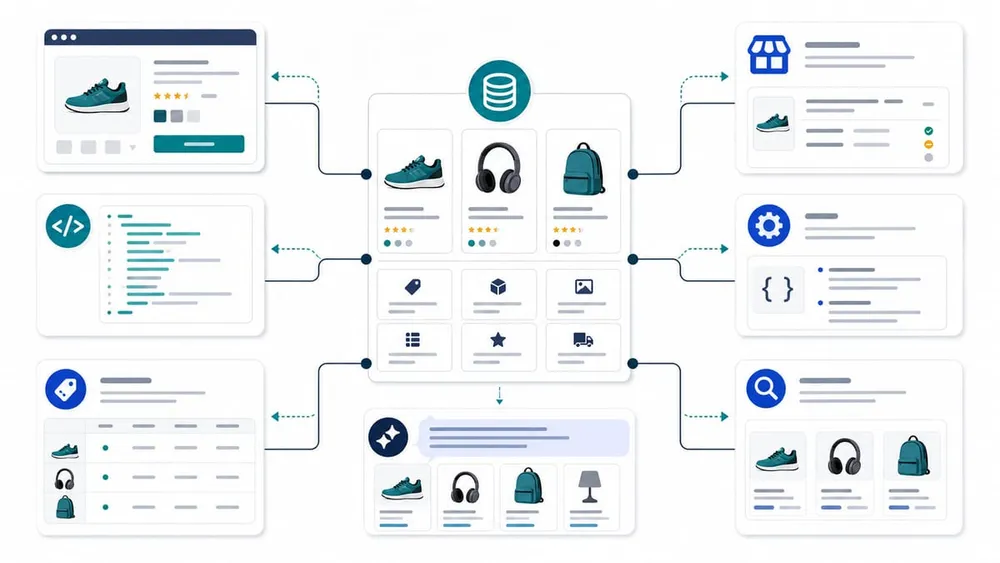
Structured product data is not one schema tag. It is the controlled product record that feeds your storefront, CMS, search, catalog feeds, APIs and AI discovery surfaces.
Identity and Names
Stable product IDs, SKUs, GTINs where available, brand, canonical URL, category and product titles that do not hide important variant facts inside inconsistent naming conventions.
Descriptions and Attributes
Clear descriptions plus structured specifications such as material, fit, dimensions, compatibility, ingredients, capacity, use case, care, warranty and safety constraints.
Price and Availability
Current price, currency, sale period, GST treatment, stock state, backorder rules, pickup or delivery availability, and the same values at product page and checkout.
Variants and Categories
Correct parent-child product relationships, variant option names, colour and size values, taxonomy alignment, discontinued variants and category-specific attributes.
Reviews and Trust Signals
Ratings, reviews, return policy, shipping details, warranty, certifications, FAQs, product claims and proof points that help shoppers and systems evaluate relevance.
Schema, Feeds and APIs
Product and Offer structured data, Merchant Center or catalog feeds, search indexes, public catalog APIs and internal APIs generated from the same authoritative source.
Why CMS and Commerce Architecture Matters
Poorly structured catalogs do not only create admin inconvenience. They create interpretation risk. If a product's real specification lives in a PDF, its variant logic lives in a product title delimiter, its buying guide lives in a CMS block, its price lives in the commerce platform, and its feed uses a weekly spreadsheet export, every discovery system has to reconcile a fragmented record.
AI systems may encounter the product through several paths: a crawled product page, a Merchant Center feed, Shopify Catalog, a search index, a marketplace feed, a public API, a browser-agent reading of the DOM, or a generated answer grounded in indexed pages. The more those paths disagree, the more likely the product is misunderstood, missed, mismatched or presented with stale details.
The better architecture is not always a full replatform. It is clear ownership. Commerce should usually own live price, availability, checkout rules and order constraints. A PIM or commerce platform may own product specifications and identifiers. The CMS should enrich the product with editorial context, comparison guidance, FAQs and brand content while remaining tied to stable product IDs. Feeds, schema and APIs should be generated from those sources rather than maintained as separate manual fields.
| Weak catalog pattern | AI/search risk | Better pattern |
|---|---|---|
| Variant details encoded only in product titles | Agents may group, filter or recommend variants incorrectly. | Structured option fields, consistent variant IDs and clear parent-child relationships. |
| Schema maintained separately from commerce data | Markup can show stale price, stock or policy details. | Generate Product and Offer markup from the same values shown on the product page. |
| CMS copy not connected to product IDs | Buying guides and FAQs may describe products that have changed or been retired. | Attach CMS enrichment to canonical products, categories or product collections. |
| Feed exports run without reconciliation | Merchant Center, product page and checkout may disagree. | Automated feed or API updates with diagnostics and mismatch alerts. |
| Product facts hidden in images or PDFs | Systems may miss important compatibility, dimensions or claims. | Visible HTML plus structured attributes, downloadable assets and accessible media. |
This is an implementation recommendation derived from Google, Shopify and Merchant Center guidance. It is not a promise that better structure guarantees AI inclusion, ranking or a specific search display.
Structured Data Improves Conversion, Not Just Visibility
The strongest Shopify finding is not simply that AI referral traffic grew. It is that structured data changed downstream behaviour. Shopify reported that AI-referred shoppers converted at twice the rate when AI used structured Shopify Catalog data rather than scraped or third-party feed information.
That makes sense. A shopper who asks an AI assistant for a product that fits a specific need is not looking for a generic category page. They may be asking for a watch under a certain size, a child seat that fits a particular vehicle setup, skincare without a specific ingredient, or equipment compatible with a model they already own. If the catalog has structured attributes, the system can match the real constraint. If it has only a paragraph and a product image, the system has to infer.
Better product data can improve conversion in several ways:
- More accurate recommendations: the product chosen by the system is more likely to match the shopper's constraint.
- Less expectation mismatch: price, availability, variants, delivery and returns are less likely to surprise the shopper on arrival.
- Stronger product pages: customers landing directly on PDPs can confirm specifications, reviews and fit without returning to search.
- Better on-site discovery: the same attributes power filters, comparisons, recommendations and internal search.
- Cleaner analytics: consistent identifiers make it easier to compare AI, organic, paid, marketplace and email performance.
The caution is equally important. Structured data is not a magic AI ranking field. Google says there is no special schema.org markup required for generative AI search, and Search result enhancements are shown at Google's discretion. The reason to structure product data is broader: it improves machine understanding, eligibility, trust, page usefulness and operational consistency.
Six Areas Every Online Store Should Audit
Start with the foundations that help both Google Search and AI systems understand, verify and recommend your products.
Product Schema
Validate Product, Offer, AggregateRating, review, shipping, return and variant markup where supported. Generate markup from source data, not separate SEO-only fields.
Merchant and Catalog Feeds
Review Google Merchant Center, Shopify Catalog, marketplace and paid-media feeds. Check processing errors, freshness, rejected items, custom mappings and missing attributes.
Clean APIs
Expose controlled catalog, price, availability, product policy and search endpoints where needed. Use stable identifiers, versioning, authentication, rate limits and logs.
Canonical Product Truth
Name the owner for titles, descriptions, specs, images, claims, prices, stock, categories and reviews. Remove duplicate manual fields that age differently.
Fast Product Pages
Ensure product pages are indexable, canonical, mobile-friendly, quick to render, accessible, internally linked and clear for shoppers arriving directly from deeper-funnel journeys.
CMS and Commerce Integration
Connect buying guides, FAQs, comparison content and campaign copy to real product and category IDs, then test that schema, feeds, pages and checkout remain aligned.
A Practical 30-Day AI-Readiness Plan
Week 1: Map the catalog truth
- Choose a sample containing bestsellers, long-tail products, variants, sale items, out-of-stock items and high-consideration products.
- List the authoritative source for title, description, category, attributes, price, stock, shipping, returns, reviews and product claims.
- Document where each field is published: product page, schema, feed, search index, API, CMS block, ads, marketplace and checkout.
Week 2: Measure completeness and consistency
- Check whether each product has a clear title, category, image, description, specifications, variant data, price, availability, reviews and policy information.
- Compare product page, JSON-LD, Merchant Center or catalog feed, internal API and checkout values.
- For Australian stores, confirm GST, unavoidable fees and displayed totals are handled consistently with ACCC price display guidance.
Week 3: Fix the publishing paths
- Generate schema from commerce data rather than hand-maintained fields.
- Automate feed or API updates for price, availability and product changes.
- Map custom fields, metafields or metaobjects into catalog outputs where platform tooling supports it.
- Remove stale manual overrides and old category logic that no longer matches the product model.
Week 4: Validate, monitor and report
- Run structured data validation and review Search Console, Merchant Center and platform diagnostics.
- Track AI referral, organic search, paid, marketplace and internal-search performance side by side.
- Create mismatch alerts for product page, feed, schema and checkout differences.
- Define an owner and response process for product-data incidents during promotions, launches and stock changes.
This plan creates useful value even if AI shopping adoption changes slowly. Cleaner product data improves SEO, search filters, merchandising, support, analytics, paid feeds and conversion today.
Frequently Asked Questions
Short answers for ecommerce, CMS, SEO and marketing teams planning product data improvements in 2026.
Sources Checked
- Shopify: AI and organic search are doing different jobs
- Search Engine Land: Shopify AI referrals up 197%, but organic search still leads traffic
- Google Search Central: Optimizing your website for generative AI features on Google Search
- Google Search Central: Introduction to Product structured data
- Google Merchant Center: Product data specification
- Google Merchant Center: Supported structured data attributes and values
- Shopify Help Center: Shopify Catalog and product discovery for agentic storefronts
- Shopify Help Center: Mapping your product data sources for Shopify Catalog
- Shopify Help Center: Category metafields
- ACCC: Price displays
Find the Product Data Gaps Before AI Search Does
VaniTech can audit your product schema, catalog architecture, CMS and commerce integration, Merchant Center feeds, APIs, page speed and AI visibility foundations.